



Treatment and management with Canesten®
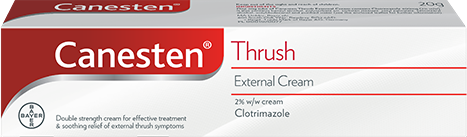
Vaginal thrush (also known as vaginal yeast infection or vulvovaginal candidiasis) is very common and will affect approximately 3 in 4 women at least once in their lifetime.1 It is usually harmless2 and sometimes clears up on its own;1 however symptoms can be unpleasant, and many women will want treatment for symptom relief.

9/10 women would recommend Canesten products for relief of thrush3
After reading this module, you will be able to:
Recognise what vaginal thrush is, its symptoms and common causes
Understand how to treat thrush and identify which Canesten format would be best for your customer
Offer self-care advice to ease and prevent a thrush infection
Identify when a customer may need to be referred for additional help
Click on the flashcards below to learn more about thrush.
Thrush is a fungal infection caused by the overgrowth of a fungus called Candida albicans. Fungi like Candida thrive in warm, moist and airless places, making the vagina preferable. Small numbers of Candida do live on the skin in and around the vagina; however, the balance of bacteria in the vagina changes can change and cause Candida to multiply, leading to thrush symptoms.
To understand more about identifying thrush and distinguishing it from BV, visit here.
Sometimes thrush symptoms are minor and self-limiting. However, often the symptoms can cause significant discomfort. There are 6 main symptoms of thrush:






Symptoms that would suggest a differential diagnosis include:
A fishy odour
Bleeding between periods or after sex
Frequent urination
A rash or blister on the skin of the vulva
Soreness without itching
Symptoms that indicate a urinary tract infection, e.g. fever
For more information about UTIs, visit here.
The natural balance that keeps Candida under control can be upset by many factors, including:
Pregnancy*
Diabetes (especially when it is poorly controlled)
Antibiotic medication
A weakened immune system, e.g. from chemotherapy
Hormone replacement therapy
Pregnant women and those with a weakened immune system should be referred to their GP.
*Care should be taken when recommending medicines for use in pregnancy as medicines can cross the placenta and may affect the fetus.
The following customers should be referred:
If they are unsure whether they have thrush or this is the first time they have had these symptoms
If they have not previously had thrush diagnosed by a doctor
If they are pregnant or breastfeeding
If they are under 16 or over 60
If they have had recurrent episodes of thrush (more than twice in six months)
If they have a weakened immune system
They or their partner have ever had a sexually transmitted disease
They have ever had an allergic reaction to any vaginal antifungal products
They have any of the following symptoms:
Irregular vaginal bleeding
Abnormal vaginal bleeding or a blood-stained discharge
Ulcers, blisters or sores of the vagina or vulva
Lower abdominal pain
Pain or difficulty in passing urine
Fever or chills
Feeling sick or vomiting
Diarrhoea
A foul smelling discharge from the vagina.
Most cases of vaginal thrush are caused by the fungus Candida albicans.1 Typically short-course treatments with azoles effectively treat uncomplicated thrush; in fact, treatment with azoles results in relief of symptoms and negative cultures in 80%–90% of patients who complete therapy.5
Azoles are a class of antifungal medicines that inhibit fungal growth by targeting ergosterol synthesis; a critical component of the fungal cell membrane. They are particularly good at managing fungal infections due to their broad-spectrum activity, efficacy and relatively favourable safety profile.6
The two types of azoles available OTC to treat vaginal thrush are FLUCONAZOLE and CLOTRIMAZOLE.
They are antifungal medicines that work by increasing permeability of the fungus cell membrane, causing the contents to leak out.
This kills the fungus and treats the infection.7,8
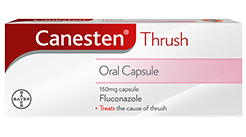
Available as Canesten® Thrush Oral Capsule
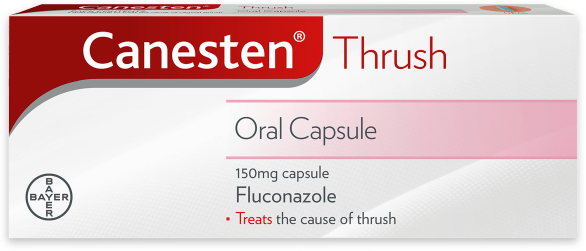
Canesten® Thrush Oral Capsule
Fluconazole 150mg (P)
Fluconazole is available OTC as an oral capsule and is indicated to treat acute or recurrent thrush. It can also be used for the treatment of partners with associated candidal balanitis (thrush of the penis head).
The fluconazole oral capsule is taken as a single dose and should be swallowed whole with a glass of water.
The most common side effects include headache, abdominal pain, diarrhoea, nausea and vomiting.
Symptoms should disappear within two days of treatment. If no improvement is seen after 7 days they should see their GP.
Canesten Thrush Oral Capsule is NOT suitable for pregnant or breastfeeding women.*
*Care should be taken when recommending medicines for use in pregnancy as medicines can cross the placenta and may affect the fetus.
Clotrimazole is available in various topical formulations in the Canesten® range. This includes:
A traditional
pessary
A soft gel
pessary
An internal
cream
An external
cream
Helping your customer choose the best formulation for them is largely based on their personal preference. However, you should understand the differences between these various formulations in order to aid your recommendations.
Click through the carousel to familiarise yourself with the differences between these formulations.
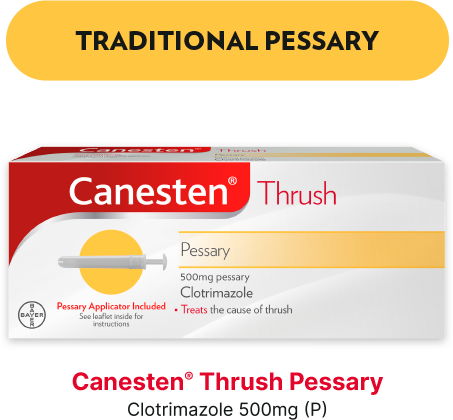
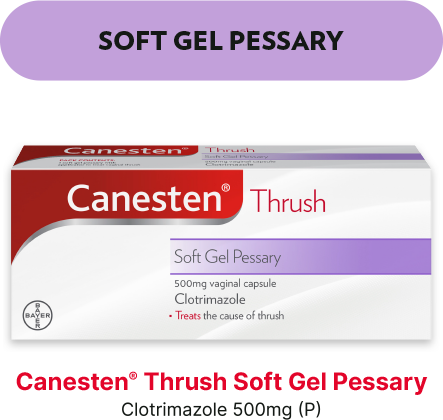
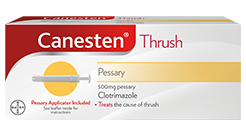
Pessaries (vaginal tablets) provide treatment of cause and symptom relief by delivering antifungal medication directly to the site of infection.
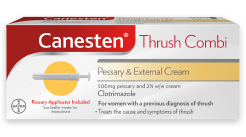
A pessary should be inserted into the vagina, as high as possible, using an applicator, at nighttime. It is important that women follow the instructions carefully to ensure they are using the medicine correctly and getting the desired effects. The applicator for Canesten® Thrush Pessary has been redesigned in a familiar tampon-like style with a rounded tip, as well as an optimal length, guide zone and ergonomically shaped plunger for ease of use.
Pessaries require moisture in the vagina to dissolve completely, otherwise undissolved pieces of the pessary may crumble out of the vagina as the user moves around. Inserting the pessary as high as possible and at nighttime helps prevent this from happening. As the pessary dissolves in the vagina it may leave a white chalky residue, so it may be helpful for customers to wear a panty liner.
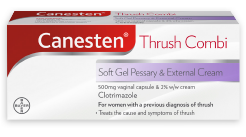
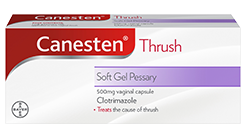
Some women may find using pessaries uncomfortable. The Canesten® range also contains the soft gel pessary format, which is designed to be more comfortable to insert for some women.
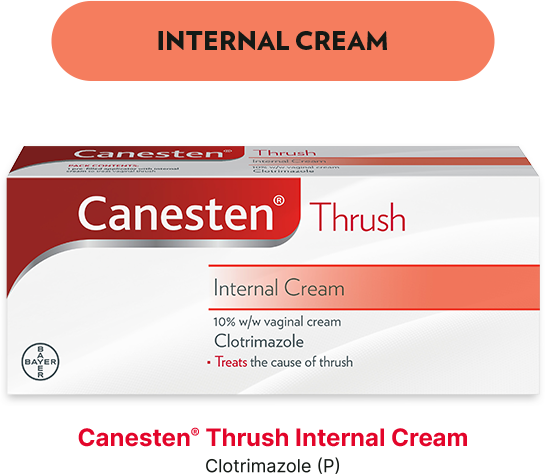
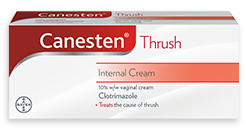
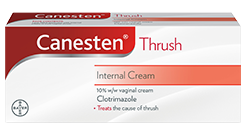
Canesten® Thrush Internal cream is indicated for the treatment of thrush. Using a pre-filled applicator, the cream is inserted as deeply as possible into the vagina at night. Non-pessary products such as creams may be more suitable for women suffering from vaginal dryness.
The cream is deposited in the vagina, but it is quite common to notice a slight discharge after using the cream and therefore it may be helpful to wear a panty liner.
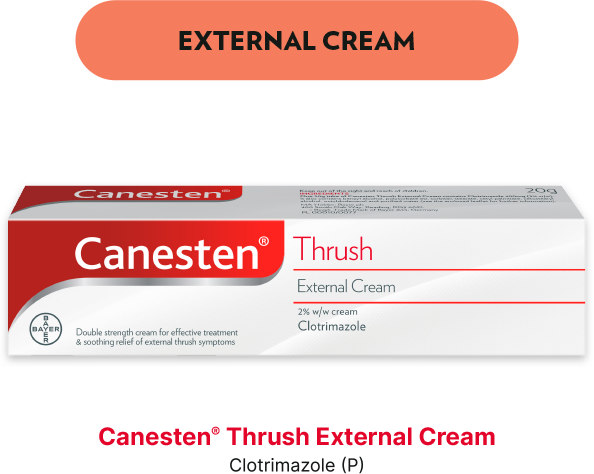
Canesten® Thrush External Cream is recommended for the treatment of candidal vulvitis, and should be used as an adjunct treatment of thrush. It can also be used for treatment of the sexual partner’s penis, if appropriate, to prevent re-infection.
It should be thinly applied two or three times daily and rubbed in gently. Treatment should continue until symptoms of the infection disappear. However, if symptoms do not improve within seven days, they should be referred to their GP. If symptoms do not improve within seven days, a GP should be consulted.
Advise customers to avoid vaginal intercourse while they have active vaginal thrush and during use of Canesten® because your partner could become infected. Also advise customers that clotrimazole can damage condoms and diaphragms. This means contraception might not work, so extra precautions should be taken for at least five days after treatment.
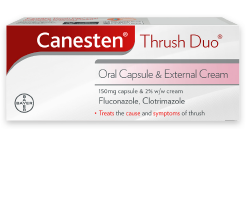
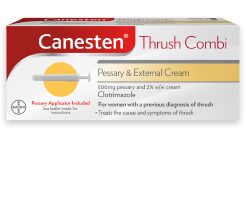
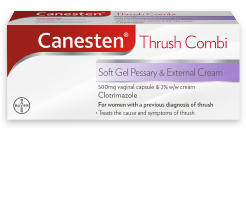
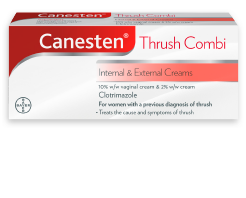
REMEMBER, the Canesten® range offers COMBINATION PACKS that can be offered to your customers. These packs contain Canesten® Thrush External cream, which can help with the external symptoms of the infection (irritation of the vulva), along with a pessary or internal cream to target the area of infection directly.
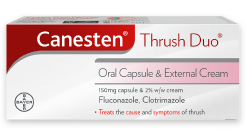
†Canesten® brand offers combined treatment in Canesten® Thrush Duo and Canesten® Thrush Combi products.
As mentioned above, disruption of the vaginal microbiome can cause overgrowth of Candida albicans, leading to thrush. Think about some things you could advise your customer to do/not do to ease thrush and help prevent it from coming back.
Click either ‘Do’ or ‘Don’t’ next to the following statements:
| EASING SYMPTOMS | DO | DON'T |
|---|---|---|
| Avoid vaginal sex while having thrush or using using Canesten(R) |
| PREVENTING RECURRENCE | DO | DON'T |
|---|---|---|
| Wash the vagina with water and an emollient | ||
| Wear cotton underwear | ||
| Wear tight-fitting jeans and nylon underwear | ||
| Wash the vagina with soaps and perfumed shower gels | ||
| Use vaginal deodorant and douches | ||
| Dry the genital area properly after washing |
Now put your knowledge into practice. Work through the following customer scenarios and think about which products would be best suited to the following women.

27-year-old Cadence has thrush. She had a previous infection about 9 months ago after finishing a course of antibiotics. She wants something to take straight away to treat the vaginal thrush, and something she can use to relieve the external itching. She confirms that she is not pregnant or breastfeeding, has no medical conditions and does not take any regular medicines.
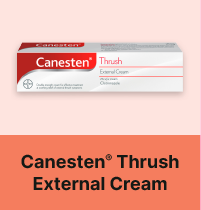
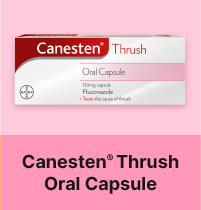
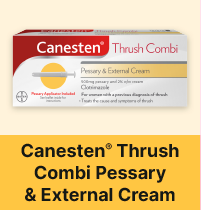
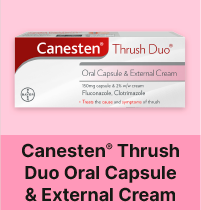

TRY AGAIN! Although this product may relieve the external symptoms, Cadence also wants something she can take straight away to treat the vaginal thrush. TRY AGAIN! Although she can take this product ‘right now’, she also wants something she can use externally to relieve the uncomfortable symptoms. TRY AGAIN! Cadence is looking for a product to use straight away to treat the vaginal thrush. Although this combination product does contain the external cream which will help her symptoms, the pessary is recommended for use at night. TRY AGAIN! Cadence could be offered treatment.
CORRECT! This combination contains the fluconazole oral capsule, which can be taken right away to treat the vaginal thrush, and the external cream to relieve her external symptoms.

47-year-old Clara has thrush. She tells you that she has an unopened Canesten® Thrush External Cream at home but wants to purchase a pessary as she used that when she last had an infection about a year ago. She tells you that she dislikes using a pessary, especially as she’s had uncomfortable vaginal dryness recently, but thinks she has no choice as she doesn’t like swallowing medicines. She confirms that she is not pregnant or breastfeeding, has no medical condition and does not take any regular medicines.
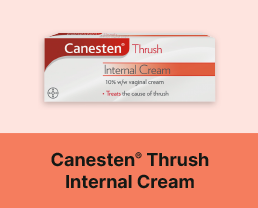
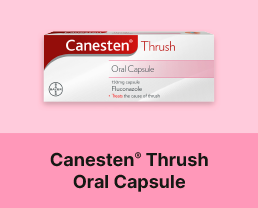
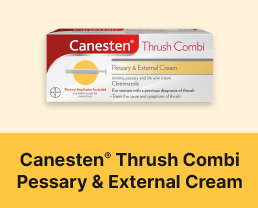

TRY AGAIN! Clara has told you that she doesn’t like swallowing medicines. TRY AGAIN! Although she has requested the pessary, there is a better option for her as pessaries require a moist environment, and she doesn’t like using them. TRY AGAIN! Clara could be offered treatment.
CORRECT! The internal cream may be better suited for Clara as she has vaginal dryness and this isn’t an oral formulation. She can also use this alongside the external cream she has at home.

20-year-old Chelsea has thrush. She has had thrush before and has used Canesten® products in the past, with successful outcomes. She tells you that she is 3 months pregnant. She doesn’t take any regular medicines or have any medical conditions.
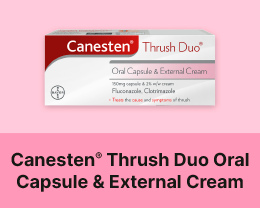
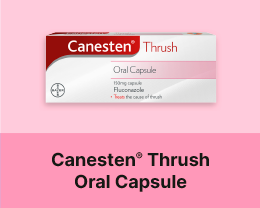
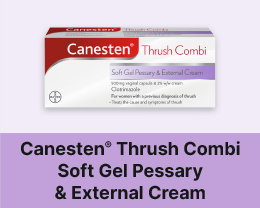

TRY AGAIN! Chelsea is pregnant and fluconazole is not suitable for use during pregnancy. TRY AGAIN! Chelsea is pregnant and fluconazole is not suitable for use during pregnancy. TRY AGAIN! While clotrimazole is generally considered safe during pregnancy, medicines can affect the unborn baby. As Chelsea is pregnant, she should be referred to her GP before taking any medicine in pregnancy.
CORRECT! Chelsea is pregnant, so shouldn't be offered any products. She should be referred to her GP for further advice.
1. Tidy C. Vaginal Thrush. Patient 2024. Available at: https://patient.info/sexual-health/vaginal-discharge-female-discharge/vaginal-thrush-yeast-infection#how-common-is-thrush
2. NHS. Thrush in men and women. 2023. Available at: https://www.nhs.uk/conditions/thrush-in-men-and-women/
3. Zhang L, et al. Vulvovaginal candidiasis: A real-world evidence study of the perceived benefits of Canesten®.
SAGE Open Med. 2022 Mar 28;10:20503121221085437 (n=441)
4. Sobel, JD. Genital Candidiasis. Medicine. Vol 42, Issue 7, June 2014, p364-368.
5. CDC. Vulvovaginal Candidiasis STI Treatment Guidelines 2021. Available at: https://www.cdc.gov/std/treatment-guidelines/candidiasis.htm#print
6. Gaber S. Azoles: A Complete Guide to Antifungal Agents, Their Mechanism, Clinical Applications, and Safety. 2024.
Available at: https://forum.facmedicine.com/threads/azoles-a-complete-guide-to-antifungal-agents-their-mechanism-clinical-applications-and-safety.88659/
7. NHS. Common questions about fluconazole. 2023. Available at: https://www.nhs.uk/medicines/fluconazole/common-questions-about-fluconazole
8. NHS. Common questions about clotrimazole for thrush. 2022. Available at: https://www.nhs.uk/medicines/clotrimazole-for-thrush/common-questions-about-clotrimazole-for-thrush/
Online references last accessed September 2025.
CLICK HERE for Canesten® Thrush Combi Pessary & External Cream 500mg / 2% w/w pessary & cream Product Information. RRP (excl. VAT): £17.83.
CLICK HERE for Canesten® Thrush Combi Soft Gel Pessary & External Cream 500mg / 2% w/w vaginal capsule & cream Product Information. RRP (excl. VAT): £17.83.
CLICK HERE for Canesten® Thrush Duo Oral Capsule & External Cream 150mg / 2% w/w capsule & cream Product Information RRP (excl. VAT): £16.41.
CLICK HERE for Canesten® Thrush Combi Internal & External Creams 10% w/w / 2% w/w vaginal cream & cream Product Information RRP (excl. VAT): £17.83.
CLICK HERE for Canesten® Thrush Pessary 500mg pessary Product Information. RRP (excl. VAT): £10.99.
CLICK HERE for Canesten® Thrush Soft Gel Pessary 500mg vaginal capsule Product Information. RRP (excl. VAT): £13.33.
CLICK HERE for Canesten® Thrush Internal Cream 10% w/w vaginal cream Product Information. RRP (excl. VAT): 5g £11.74.
CLICK HERE for Canesten® Thrush External Cream 2% w/w cream Product Information. RRP (excl. VAT): 20g £9.58.
CLICK HERE for Canesten® Thrush Oral Capsule 150mg capsule Product Information. RRP (excl. VAT): £12.08

Content developed by Bayer working together with CIG Healthcare Partnership.
© 2025 CIG Healthcare Partnership
September 2025