


 3 Min
3 Min In Practice

Follow this topic

Bookmark

Record learning outcomes
Do you have an area of special interest?
I studied respiratory conditions while qualifying as a prescriber, but now I mostly deal with common clinical conditions.
Have you expanded your scope of practice?
Yes, over time I have extended my scope to include a wider range of conditions.
How did you go about that?
I completed a number of relevant NHS National Education for Scotland (NES) TURAS courses,
I read related NICE Clinical Knowledge Summary (CKS) topics, and very recently I started exploring Royal College of Pharmacy (RCPharm) prescriber resources.
What prescribing services are you providing?
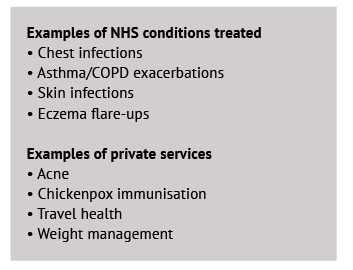
The NHS Common Clinical Conditions service (Pharmacy First Plus), and some private services including travel health and weight management. We also prescribe for people who are not eligible to get NHS prescriptions.
What is the balance between private and NHS services?
For number of consults, it is more NHS at the moment, but that may be skewed as [at the time of writing] we are just coming out of winter. Normally it is around 50/50.
How much time do you spend daily doing consultations?
This varies widely. A quieter day can be an hour or so. On a busy day, maybe half the day or more. Some private consults (for example, initial weight management) can take more time.
How do you find the time?
Traditional dispensing in our pharmacy is at a medium level and we also use DigiPharma, a clinical consultation platform, which helps to structure and streamline consultations.
Do you have more than one pharmacist?
Yes, on two days out of six we have two pharmacist independent prescribers.
Do you use automated dispensing technology?
No.
What are the risks involved in providing this service?
There are many risks associated with prescribing. However, we manage that by only working within our competences and ensuring appropriate risk assessments are carried out for each service.
Is it financially successful for the pharmacy?
I’d say so. The private services we offer are an important part of that.
Is it professionally rewarding?
Yes. In the way PGDs allowed us to help more patients, albeit with certain restrictions, I feel prescribing allows us to take that a little further.
Do you get feedback about the service from patients or others in primary care?
Mostly from patients who are, by and large, very grateful for the service. But we don’t get feedback from other colleagues in primary care.
What about peer support?
I’m fortunate to work alongside an experienced prescriber, with skills and knowledge that are very helpful. Also, within my company, there is a network of IPs so we help each other via chat groups.
What advice would you give someone starting out as a prescriber?
Take it one step at a time until your confidence/competence increases. Use the available resources such as the RCPharm website, the CPD modules in Pharmacy Magazine, and, if possible, attend some face-to-face educational sessions too, to consolidate your learning to date.
Once you are confident in one area, for example common clinical conditions, you might consider expanding your scope of practice. But I feel it is important not to try to do too much, too soon.
Collaboration and discussion with colleagues is also important, so try to form a network of people you can consult with and compare notes.
It is also important to contact local GP practices to let them know what you are able to do and the limitations, as this will help to streamline signposting.
|
If you would like to share your experience of being an independent prescriber email:
pm@1530.com
|

Share:


In Practice
We know you want to continue to build on your practice, why not hear from others in the sector striving to do the same.