





 24 Min
 In Pharmacy First

Follow this topic

Bookmark

Record learning outcomes
Sore throat - assessment, diagnosis and management
This toolkit is designed to support pharmacists to deliver the Pharmacy First service in England (and similar schemes in the UK) for sore throat. It covers:
- Clinical assessment and decision-making
- Management of the condition
- Communicating with patients regarding treatment decisions.
|
After reading the toolkit you will be able to:
|
|
||||||||||||||||
Introduction
Sore throat is one of the commonest presentations in primary care and community pharmacy teams have been advising effectively on the condition for many years.
Drawing on the NICE Sore throat (acute): antimicrobial prescribing guideline [NG84] and CKS Sore Throat, this toolkit will support your decisionmaking regarding the provision of self-care advice, OTC medicines, the small number of occasions when a sore throat might benefit from antibiotics, and when referral is needed.
Around 90% of sore throats that present in the pharmacy will be caused by viral infection. Clinically, it is difficult to differentiate viral and bacterial infections and the majority of both are self-limiting.
As such, it may be easy to ascribe all sore throats to viral causes. It is important, therefore, to keep an open mind for each patient who presents with a sore throat or upper respiratory tract symptoms. A good history and a comprehensive examination should allow for a confident diagnosis.
Use the clinical pathway for sore throat to help guide your diagnosis. Be alert for anyone with systemic illness or signs of sepsis, breathing difficulties or stridor, suspected epiglottitis or diphtheria, those who appear to be dehydrated, or where a pharyngeal abscess is suspected. Refer such patients urgently to A&E for further assessment or call 999.
In the UK, sore throats are one of the main reasons for prescribing antibiotics but even where there is bacterial infection, antibiotics make little difference to outcome and are unnecessary in most cases.
Check for possible differential diagnoses such as scarlet fever, quinsy, glandular fever or suspected cancer. An urgent GP referral may be necessary. Patients who are immunosuppressed or taking medicines known to cause agranulocytosis (e.g. methotrexate, sulfasalazine, carbimazole, propylthiouracil, cotrimoxazole, valganciclovir, clozapine, carbamazepine, all chemotherapy) should also be referred to their GP.
|
Be alert for epiglottitis Epiglottitis is a condition where the cartilage which covers the windpipe (epiglottis) swells and blocks the flow of air into the lungs. This results in difficulty in swallowing. Epiglottitis is suggested by severe and acute onset of sore throat and fever, muffled voice, drooling, and stridor. A child with epiglottitis prefers to sit leaning forward. Breathing tends to be tentative and careful, without marked increase in respiration rate. Inspiratory stridor and hoarseness may occur. In adults, predictors of airway compromise include sitting erect, stridor and dyspnoea. Do not examine the throat of anyone with suspected epiglottitis as this may precipitate closure of the airway. |
The consultation
A useful way to think about the consultation is to cover the 3 E’s – Empathise, Evaluate and Educate, summarised below.
The 3 E’s
- Empathise
- Evaluate
- Educate
CHESTSSS
- Concerns
- History/examination
- Expectations
- Symptoms explanation
- Timeline
- Shortcomings of antibiotics
- Self-care
- Safety-netting
Tweaking sentences or adding short statements to your explanations can present information in a way that is most helpful for patients.
The CHESTSSS consultation structure, developed by the Royal College of General Practitioners as part of the TARGET toolkit and based on the evidence for effective communication strategies, is a quick way to help remind you what to tweak in your discussions with patients about antibiotics in particular.
CHESTSSS can help you to remember specific phrases which:
- Reassure patients
- Increase patient understanding and satisfaction with a prescribing decision
- Avoid re-consultations
- May be particularly helpful for patients who are expecting antibiotics.
Table 1 shows how CHESTSSS could be tailored to a consultation about sore throat.
| Table 1: Communicating with patients and parents about sore throat treatment decisions | |
|
C Ask specifically about concern |
If concerns are not specifically asked about, the patient will sometimes not share their main worries for fear of being seen as ‘overly anxious’. “What are the things you are most worried about?” |
|
H Discuss history and examination |
While doing an examination, provide a ‘no problem’ commentary: “Your throat does looks red but there isn’t any white material on or around your tonsils – so that makes a viral infection more likely.” You could explain that the scoring system you are using is recommended across the UK, is used by local GPs, and that it helps to determine if antibiotics are likely to help. |
|
E Ask specifically about prior knowledge and expectations |
The only way of actually knowing what patients want or expect is to ask them. “How do you think I could most help you today?” or “How do you feel about antibiotics?” |
|
S Provide non-serious explanation for symptoms |
“Your body reacts to viruses or bacteria by fighting the infection and this reaction causes inflammation – this is normal. It’s why the throat looks red.” Patients often consult for reassurance rather than with an expectation of being given an antibiotic. Make a clear statement combining a negative and a positive. “An antibiotic won’t help but I can give you something else that will help.” |
|
T Be specific about illness timeline or usual course |
Give an accurate prognosis. “A typical sore throat can take a week to improve.” |
|
S Explain shortcomings of antibiotics |
Antibiotics don’t help with pain but side-effects, such as diarrhoea, nausea and rash, can be experienced by up to one in 10 people. |
|
Back-up or delayed antibiotic prescriptions |
For patients whose clinical score does not warrant antibiotics it is appropriate to advise returning if they do not feel better after three to five days, or if they are feeling worse. The patient can then be re-evaluated. |
|
S Self-care advice |
For most people symptom relief is more effective than antibiotics. “Pain in the throat is due to the inflammation. You can take medicated lozenges, paracetamol, and/or ibuprofen, which will help the pain and soothe the inflammation.” |
|
S Safety-netting advice |
Provide patients with specific information on red-flag symptoms and when they should seek further help. “If your child is still poorly in a week, or if s/he develops a fever, call or come back and see me.” |
|
Check understanding |
Summarise what has been found and your advice. Check that the patient is reassured and satisfied. |
Using clinical scoring systems
Information gathering for sore throat will include three elements:
- The pharmacist’s usual questioning
- Palpation of the neck
- Examining the appearance of the throat.
These last two actions enable the use of a clinical scoring system to assess the likelihood of bacterial infection. The use of clinical scoring systems is recommended by NICE. Pharmacy First PGDs refer to FeverPAIN. Higher scores suggest more severe symptoms and a likely bacterial (streptococcal) cause. NICE makes recommendations on when antibiotics might be of benefit.
Sore throats are often associated with other symptoms of a cold, and determining whether cold symptoms, particularly a cough, are present is a useful way to triage cases.
A cold makes a throat infection less likely as a viral cause is more probable.
Use the FeverPAIN scoring system to determine next steps:
- Score 0 or 1: offer self-care advice and pain relief
- Score 2 or 3: offer self-care advice and pain relief
- Score 4 or 5:
- For mild symptoms consider pain relief and self-care as first-line treatment. Ask the patient to return to the pharmacy if there is no improvement in 3-5 days for reassessment
- For severe symptoms consider offering an antibiotic using a PGD.
Differential diagnoses
In making a diagnosis be aware of the common (non-streptococcal) infectious causes of acute sore throat, and their signs and symptoms.
These are set out in the NICE CKS on acute sore throat. They include:
- Common cold – suggested by rhinorrhoea, nasal congestion and cough
- Influenza – suggested by headache, weakness and fatigue, myalgia, malaise, anorexia, insomnia, dry unproductive cough and fever
- Pharyngoconjunctival fever – suggested by fever and conjunctivitis. Malaise, myalgia, headache, rhinitis, and cervical adenitis may also be present
- Acute herpetic pharyngitis – suggested by vesicles and shallow ulcers on the palate (not always present)
- Glandular fever – suggested by pharyngitis of longer than several days’ duration, adenopathy and splenomegaly
- Covid-19 – suggested by fever, new continuous cough, shortness of breath, malaise, muscle aches and pains, rhinorrhoea and gastrointestinal symptoms.
Non-infectious causes include:
- Physical irritation – consider in people who smoke
- Hay fever
- Gastro-oesophageal reflux disease
- Drugs that can cause blood disorders leading to infection and acute sore throat including cytotoxic drugs, carbimazole, clozapine and sulfasalazine
- Oropharyngeal cancer – suggested by hoarseness, dysphonia, sore throat, difficulty swallowing, and neck mass or adenopathy.
Key information from the patient history
Age: Streptococcal (bacterial) throat infections are more likely in children of school age.
Duration: Most sore throats will get better within seven days. If present for longer and not resolving, then the patient should be referred to the GP surgery for further advice.
Associated symptoms:
- Cold, catarrh and cough may be associated with a sore throat. There may also be a fever and general aches and pains. These are in keeping with a minor self-limiting viral infection
- Hoarseness of longer than three weeks’ duration is an indication for referral
- Difficulty swallowing (dysphagia) is sometimes seen with tonsillitis or peritonsillar abscess (quinsy) and is a sign usually requiring urgent referral
- Loss of taste or smell (or alteration in these) is a recognised feature of Covid-19, which can also cause sore throat. If this is suspected the patient should do a Covid test.
Previous history: Recurrent bouts of throat infection, such as several episodes of ‘tonsillitis’ in the past year, would mean that referral is indicated.
Smoking habit: Smoking will exacerbate a sore throat. If the patient smokes, then it can be a good time to offer advice and information about quitting.
Present medication:
- Steroid inhalers can cause hoarseness and candidal infections of the throat and mouth. Generally this happens at high doses and can be prevented by rinsing the mouth with water after using the inhaler. Poor inhaler technique can lead to large amounts of the inhaled drug deposited at the back of the throat
- Any patient taking carbimazole and presenting with a sore throat should be referred immediately. A rare side-effect of carbimazole is agranulocytosis (suppression of white cell production in the bone marrow)
- The same principle applies to other drugs associated with agranulocytosis, including methotrexate and azathioprine
- A patient receiving chemotherapy for cancer should be referred as a sore throat can be the first sign of a life-threatening infection.
|
[Source: PPE Clinical Examination and Procedural Skills]
Abnormal appearance

With a sore throat, the tonsils may swell and become red, and pus may appear on them as white spots. Symptoms typically get worse over two to three days and then gradually go, usually within a week. Often described as tonsillitis, this does not normally require treatment.
The presence of tonsillar exudate (pus on the tonsils) may increase the likelihood of a bacterial infection and is one of the items that scores in FeverPAIN. However, exudate is sometimes seen with viral infections and sometimes the throat can appear almost normal without exudates in a streptococcal (bacterial) infection.
Tonsils often have white patches on them in healthy people. These are part of the lymphatic immune system and are sometimes called tonsillar crypts.
An important point is some people may not have tonsils. They may not volunteer this information so their absence on examination may be a surprise.
Tonsillectomy has been a relatively common procedure until recent years. It is still possible to have a sore throat and potentially a bacterial infection after a tonsillectomy.
Who to refer and red flags
Most of the people who attend the pharmacy with a sore throat will be unwell and have pain but are not severely ill. A few patients may attend who have symptoms suggesting more severe illness or who are at risk of severe illness.
The most important requirement is to recognise severely ill patients and ensure they get urgent care.
Also, some patients may seek assessment by the pharmacist but do not meet the necessary service criteria. These patients will need referral to their GP practice (or to urgent care, if required).
The NHS Health A-Z lists the following symptoms as red flags for sore throat. Patients (including children) should call 999 or go straight to A&E, if they are:
- Having difficulty breathing or are unable to swallow
- Drooling – may be a sign of not being able to swallow
- Making a high-pitched sound during breathing (called stridor)
- Having severe symptoms that are getting worse quickly.
The other diagnosis to consider is sepsis – see Table 3.
Patients who appear dehydrated may also need urgent referral. If quinsy or another throat/neck abscess is suspected, these should be referred to A&E urgently.
|
Key treatment counselling points
|
|
||||||
GP referral
Same day
- Has symptoms and signs of a more serious illness or condition
- Has a persistent high fever (>38°C)
- Has significant difficulty in swallowing (dysphagia)
- Has a high risk of complications – immunosuppressed or on treatment for cancer
- Is taking carbimazole, methotrexate or azathioprine
Less urgent referral
- Not systemically unwell but condition not covered by PGD or not meeting PGD criteria
- Masses/unilateral swellings (possible cancer)
- Persistent mouth ulcer/lesions (possible cancer)
- Recurrent problem, or treated within last month
- Has had the sore throat, and is not getting better, for longer than seven days
- Persistent, ‘low grade’ sore throat for over three weeks; may be unilateral (possible cancer)
- Has had recurrent bouts of throat infection/tonsillitis
- Has hoarseness that has lasted longer than three weeks.
Treatment options
Most sore throats are self-limiting and 90% of patients feel better or improve within one week of the onset of symptoms, whatever the cause and with or without antibiotics. NICE states that “antibiotics make little difference to how long symptoms last or the number of people whose symptoms improve”.
Pharmacists can offer symptomatic treatment to provide some relief from discomfort and pain until the infection subsides. Oral analgesics are the first-line option and recommended for all patients, even those given antibiotics.
A systematic review of clinical trials found that simple analgesics (paracetamol and ibuprofen) are very effective at reducing the pain from sore throat. Some medicated lozenges and pastilles have a soothing effect.
NICE states that “medicated lozenges containing benzocaine, hexylresorcinol or flurbiprofen may help to reduce pain in adults”. There is also some evidence that benzydamine spray is effective for sore throat pain.
Antibiotics are indicated in a small proportion of sore throats and have been shown to reduce the duration of symptoms by an average of just 16 hours.
PGDs define the inclusion and exclusion criteria for different antibiotics (see above). The main contraindication is allergy/hypersensitivity – usually to penicillin.
Sources of allergy information include the individual, their carer/parent/guardian, or their National Care Record (but bear in mind these sources are not always accurate).
Using the sore throat PGDs
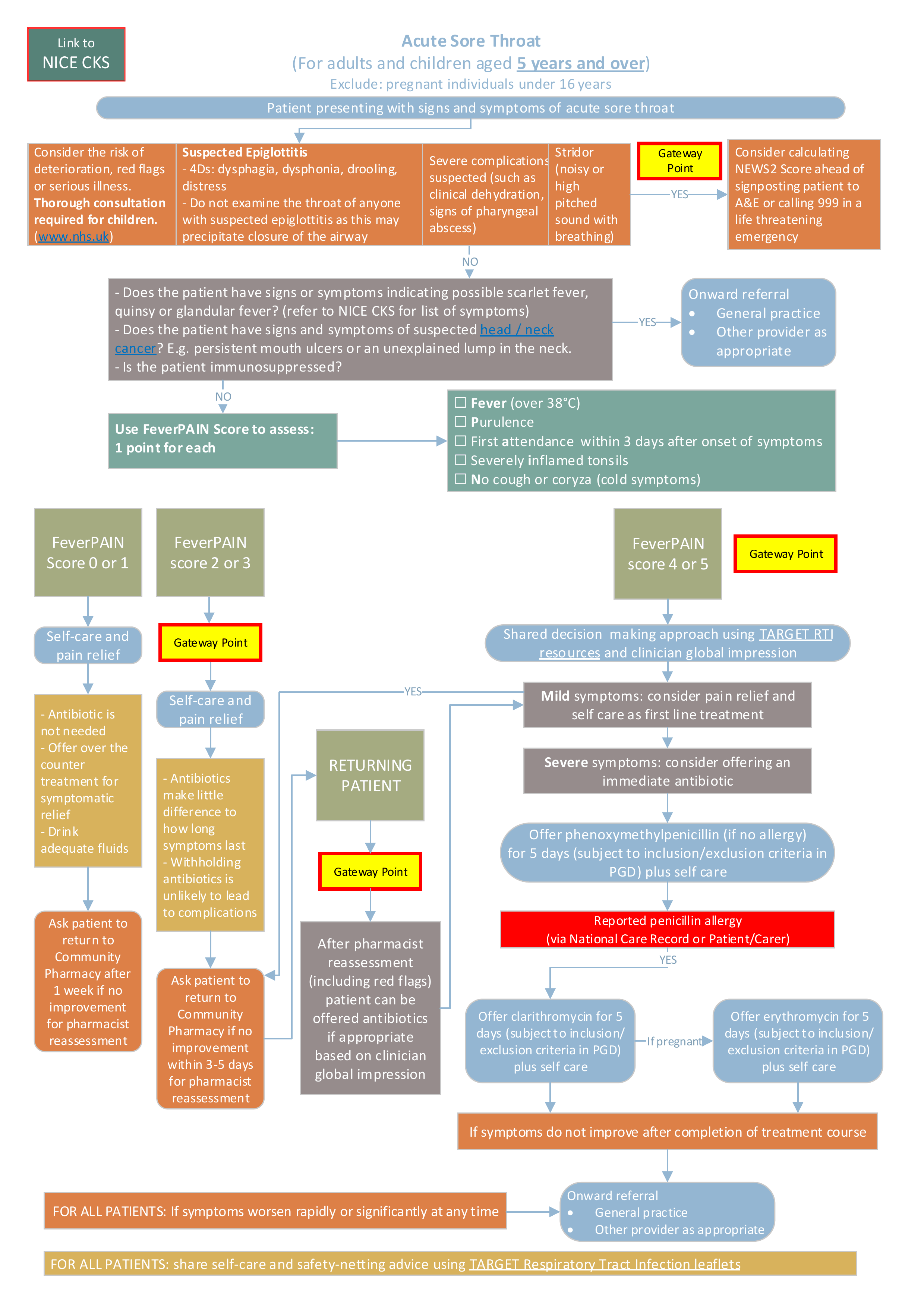
For patients who pass the Gateway Point with a FeverPAIN score of 2 or 3 (self-care advice), or 4 or 5 (possible antibiotic treatment), and who have acute sore throat due to suspected streptococcal infection, there are three antibiotic options for treatment:
- Phenoxymethylpenicillin – for individuals aged 5 years and over
- Clarithromycin – for individuals aged 5 years and over with reported penicillin allergy
- Erythromycin – for individuals aged 16 years and over who are pregnant, or where pregnancy is suspected, with reported penicillin allergy.
Check the patient meets the criteria for inclusion, then determine whether the patient might be excluded from treatment. General criteria for exclusion include:
- Individuals under 5 years of age
- Pregnancy or suspected pregnancy in individuals under 16 years of age
- Individuals who are immunosuppressed or are currently taking immune-suppressants (including systemic corticosteroids) or immune modulators
- Severely immunosuppressed individuals (as defined in Chapter 28a of the Green Book)
- Known hypersensitivity to phenoxymethylpenicillin (penicillin V)
- Individuals following a ketogenic diet
- Recurrent sore throat/tonsillitis (seven or more significant episodes) in the preceding 12 months
- Previous tonsillectomy
- Symptoms indicating: epiglottitis, scarlet fever, quinsy, glandular fever, diphtheria, severe/life-threatening infection or systemic sepsis
- Possible cancer, suggested by persistent mouth ulcers, presence of unilateral swelling, unable to swallow, bleeding or numbness in the mouth, red or white patches in the mouth, unexplained hoarse voice (in those over 45 years) lasting three weeks or more
- Individuals currently taking/receiving medicines known to cause agranulocytosis (e.g. methotrexate, sulfasalazine, carbimazole, propylthiouracil, cotrimoxazole, valganciclovir, clozapine, carbamazepine, plus all chemotherapy)
- Known chronic kidney disease (CKD) stages 4 or 5 (eGFR <30ml/min/1.73m²)
- Less than 3 days before receiving, or within 3 days after receiving, oral typhoid vaccine
- Concurrent use of any interacting medicine.
In addition to medication, each patient treated under a PGD should be:
- Given a Treating Your Infection – Respiratory Tract Infection patient information leaflet
- Given the appropriate medicine patient information leaflet
- Advised that acute sore throat can last for around one week, but most people will get better within this time without antibiotics, regardless of cause (bacteria or virus)
- Provide with self-care advice.
The RCGP’s TARGET antibiotic checklist can be used for counselling individuals/parents/carers (foreign language versions are available).
For criteria for exclusion, and actions to be taken if the patients are excluded from the service, see a full version of the PGDs.
|
||||||||||
Last reviewed: September, 2026
Next scheduled review: September, 2027

Share:


In Pharmacy First