




 20 Min
 In Pharmacy First

Follow this topic

Bookmark

Record learning outcomes
Diagnosis and managment of sinusitis
This toolkit is designed to support community pharmacists and their teams to deliver the NHS Pharmacy First service in England (and similar schemes in the UK) for acute sinusitis in patients 12 years and over. It covers:
- Clinical assessment and decision-making
- Management of the condition
- Communicating with patients regarding treatment decisions.
Drawing on the NICE Sinusitis (acute) antimicrobial prescribing guideline (NG79), this toolkit will support your decision-making regarding the provision of self-care advice and OTC medicines, and help identify the small number of occasions where antibiotics might be needed.
|
||||||||||||||||
Sinusitis and facial pain are common presentations in primary care. People may come into the pharmacy concerned that they have a sinus infection. Comprehensive history taking and examination will allow for a confident diagnosis.
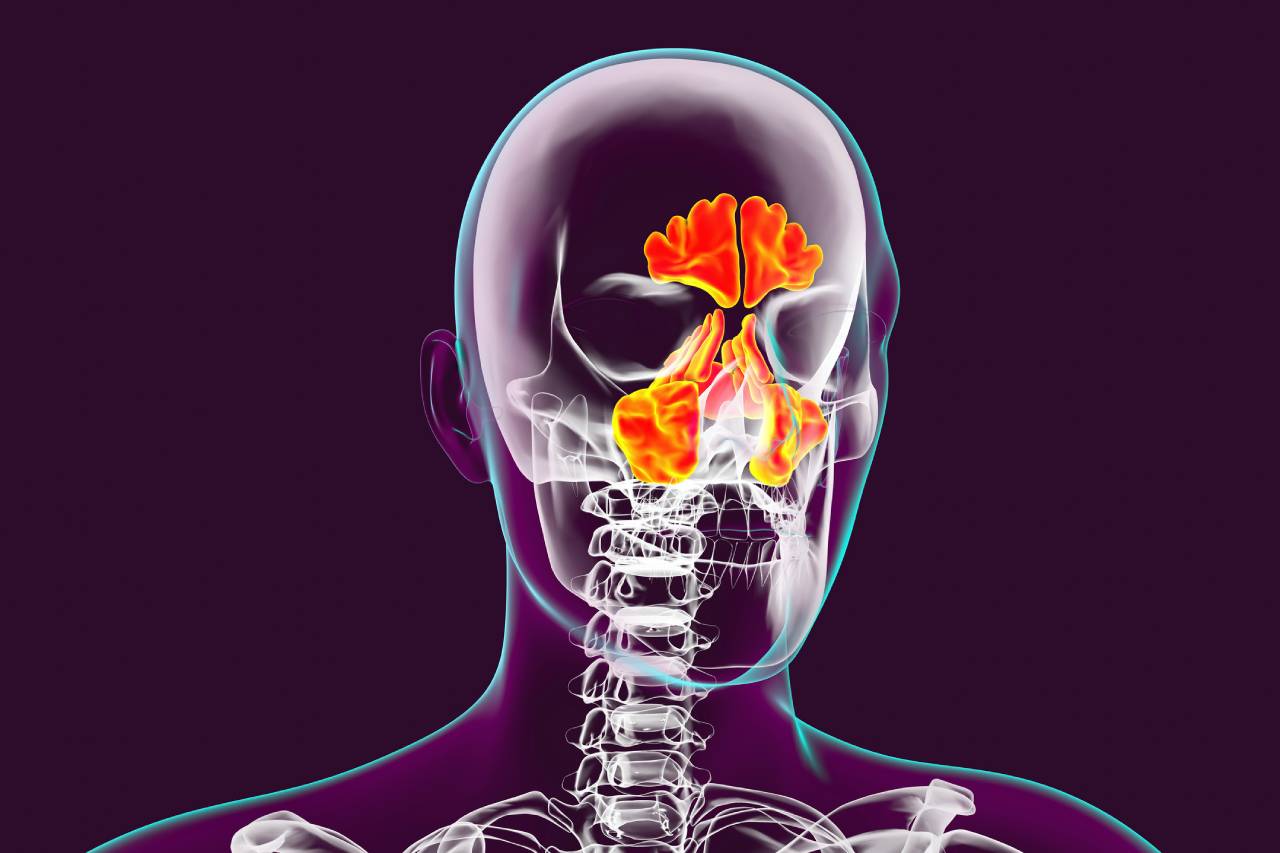
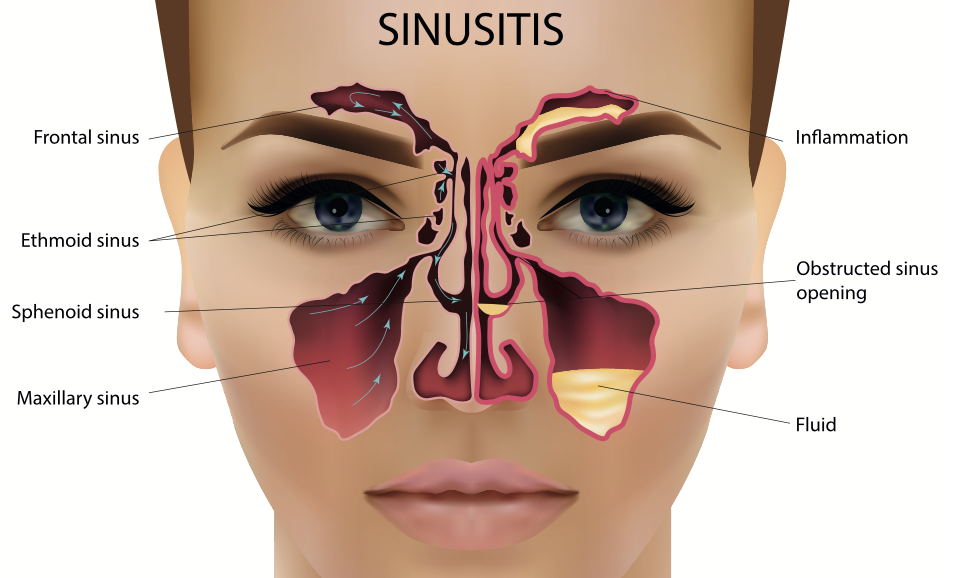
The paranasal sinuses are air-containing spaces in the bony structures adjacent to the nose (maxillary sinuses) and above the eyes. During a cold, their lining surfaces become inflamed and swollen, producing mucus. The maxillary sinuses are most commonly involved.
The secretions drain into the nasal cavity and, if the drainage passage becomes blocked, fluid builds up in the sinus. This causes pain from pressure that is called acute sinusitis. It can become secondarily (bacterially) infected, but this is rare. If this happens, more persistent pain arises in the sinus areas, and there may be fever and purulent nasal discharge.
Symptoms can last for two to three weeks, during which time most people will get better without treatment, regardless of cause (bacterial or viral). Consequently, antibiotics are not needed for most people. The number of people improving with antibiotics is similar to the number who will suffer adverse effects such as diarrhoea.
Complications of acute sinusitis are rare and withholding antibiotics is unlikely to lead to any issues.
When to suspect acute sinusitis
The clinical pathway for acute sinusitis under the Pharmacy First scheme uses the following diagnostic criteria, derived from the NICE Clinical Knowledge Summary for sinusitis:
Presence of ONE of the following signs/symptoms that suggest acute sinusitis:
- Nasal blockage (obstruction/congestion) or
- Nasal discharge (anterior/posterior nasal drip).
And ONE or more of the following:
- Facial pain/pressure (or headache) or
- Reduction (or loss) of sense of smell (in adults) or
- Cough during the day or at night (in children).
As well as a reduction or loss in a person's sense of smell, other features suggestive of acute sinusitis could be altered speech indicating nasal obstruction, and tenderness, swelling or redness over the cheekbone or periorbital areas.
To diagnose sinusitis (rather than the after-effects of a viral respiratory tract infection) symptoms should have been present for 10 days or more with no improvement.
Key information from the patient history
Age: Acute sinusitis can affect any age group but is less common in children because their sinuses are not fully developed. The Pharmacy First service in England is aimed at adults and children aged 12 years and over. Pregnant teenagers under 16 years of age should be referred.
Duration: Most cases of sinusitis will improve by day 10 and resolve in two to three weeks. Chronic sinusitis is defined as symptoms lasting for more than 12 weeks. Symptoms for around 10 days or less are more likely to be associated with a preceding cold rather than viral or bacterial acute sinusitis.
Associated symptoms:
- The affected sinus often feels tender when pressure is applied. It is typically worse on bending forwards or lying down
- The pain may be felt behind and around the eye, or over the cheek, with radiation over the forehead. Often only one side is affected
- The headache may be associated with runny nose or nasal congestion
- Fever (above 38°C) is usually an indication of bacterial infection.
Previous history: Ask whether there has been a marked deterioration in symptoms following a recent cold that had started to settle (so called 'double sickening') as this may be an indication of bacterial infection.
Patients may have had episodes of acute sinusitis previously. Recurrent episodes may relate to an incomplete response to an antibiotic (sometimes due to resistance, or anatomical abnormalities affecting drainage, or nasal polyps). Patients who have had acute sinusitis before may have the expectation that they will receive antibiotics if this has happened in the past.
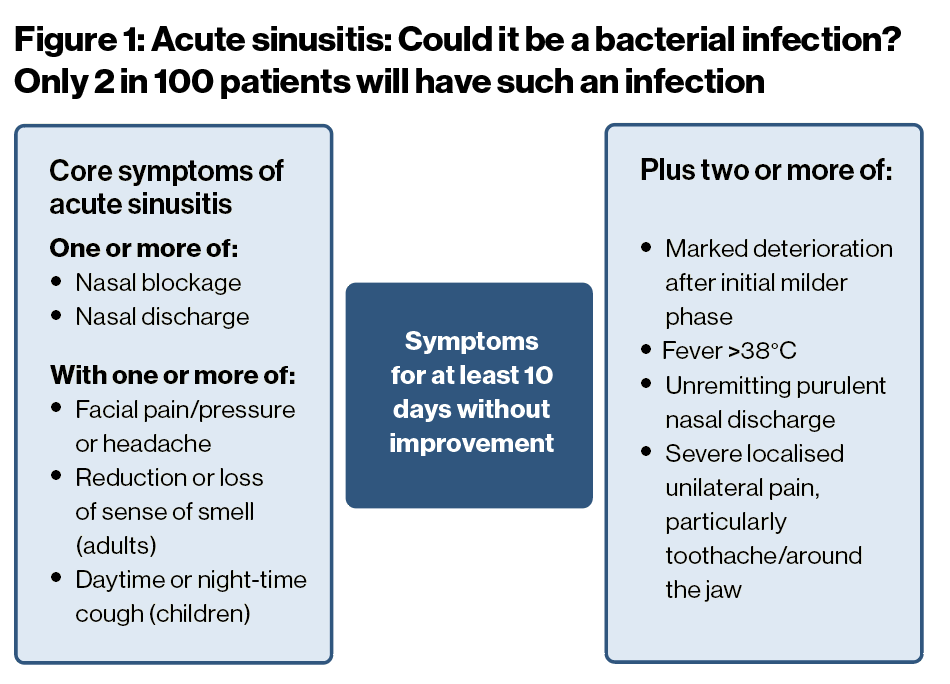
The features of a bacterial infection are summarised in Figure 1 below.
Who to refer and red flags
The PGDs for use of inhaled nasal corticosteroids and antibiotics in sinusitis give specific inclusion and exclusion criteria. The following is intended to give some pragmatic guidance on how these might be followed — it is not intended to be all-inclusive or definitive.
Most of the people who attend a pharmacy with sinusitis will be unwell and have pain but are not severely ill. A few patients may attend who have symptoms suggesting more severe illness or who are at risk of severe illness. The most important requirement is to recognise severely ill patients and make sure they get urgent care.
Many PGDs list rare or unusual causes of symptoms. Severe complications with acute sinusitis are very rare.
The most common are orbital with swelling and reduced vision; then intracranial (meningitis, encephalitis, abscess or venous thrombosis). Bony complications, presenting with swelling over the frontal bone/forehead, are the least common.
Severe complications are estimated to occur in one in 12,000 children and one in 32,000 adults with acute sinusitis who are otherwise healthy.
Some patients may seek assessment by a pharmacist but do not meet the criteria for the PGD under which the service is operating. Some of these patients may require referral to their GP practice (or urgent care, if needed).
The clinical pathway for acute sinusitis lists the following symptoms as signs of a more serious illness or condition (red flag symptoms) requiring urgent care (call 999 or go straight to A&E):
- Intraorbital (within the eye) or periorbital (around the eye) complications such as periorbital oedema (swelling) or cellulitis, displaced eyeball, double vision, ophthalmoplegia (paralysis/weakness of the eye muscles), or newly reduced visual acuity (vision)
- Bony complications such as tender swelling over the frontal bone
- Symptoms or signs of meningitis
- Severe frontal headache or focal neurological signs.
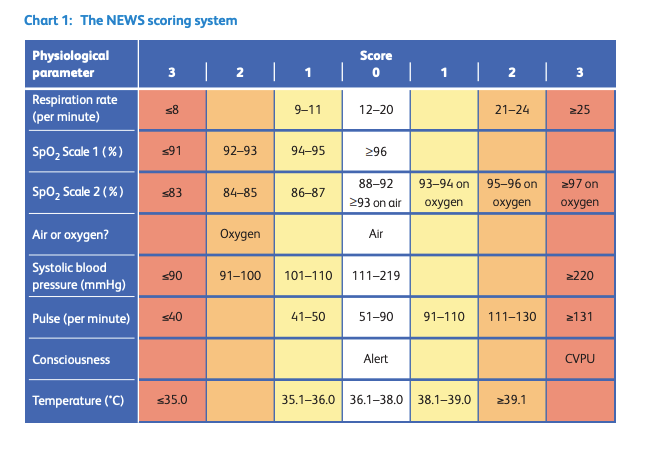
Any individual identified with symptoms of severe/life-threatening infection or systemic sepsis should be referred urgently. The clinical pathway suggests pharmacists consider calculating a NEWS2 score (see panel) ahead of signposting such patients to A&E or calling 999.
Differential diagnoses
Use the clinical pathway for acute sinusitis to guide your further actions. If acute sinusitis is unlikely, consider differential diagnoses and proceed appropriately. Other conditions presenting with similar signs and symptoms to sinusitis include:
- Upper respiratory tract infection — in most common colds symptoms peak by three days
- Allergic rhinitis — usually restricted to nasal symptoms. Consider especially if there is a prior history of allergy
- Nasal foreign body — typically causes a unilateral mucopurulent discharge or blockage (more common in children)
- Adenoiditis and tonsillitis (particularly in children) — adenoiditis can be difficult to differentiate from sinusitis in children as symptoms are similar
- Sinonasal tumour — suspect particularly if there are persistent unilateral symptoms, such as nasal obstruction, nasal discharge or nosebleeds, crusting, or facial swelling
- Turbinate hypertrophy — nasal obstruction is the predominant symptom.
Other causes of facial pain or headache include:
- Migraine
- Giant cell arteritis (temporal arteritis)
- Temporomandibular joint dysfunction
- Neuropathic or atypical facial pain
- Dental pain.
If the patient has had symptoms for less than 10 days, advise an antibiotic is not needed and provide self-care advice and OTC medicines for symptom relief.
NEWS2 scoring system
NEWS2 is a simple scoring system in which a score is allocated to six physiological measurements. The six parameters which form the basis of the scoring system are:
- Respiration rate
- Oxygen saturation
- Systolic blood pressure
- Pulse rate
- Level of consciousness or new confusion
- Temperature.
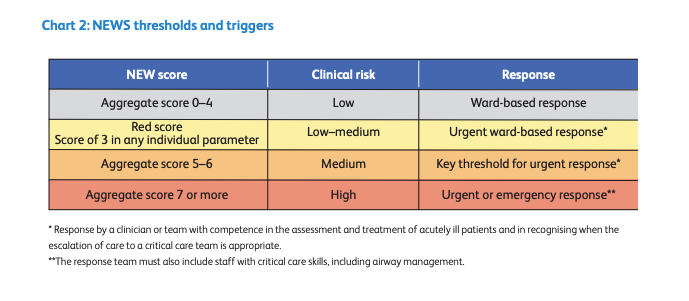
More information at: www.rcplondon.ac.uk/resources/national-early-warning-score-news-2
GP referral
These criteria are for guidance only. Pharmacists should use their professional judgement on urgency (see Clinical Pathway and PGDs for more detail).
- Same day
- Individual is severely immunosuppressed or immunosuppressed (this may include patients on chemotherapy or high dose systemic corticosteroids)
- Individual is systemically unwell but not showing signs or symptoms of sepsis
- Possible cancer suspected: unilateral (one-sided) polyp or mass, or bloody nasal discharge present
- Foreign body inserted into nasal passages
- Significant/active epistaxis (nosebleeds)
- Persistent unilateral symptoms, such as nasal obstruction, nasal discharge or nosebleeds, crusting or facial swelling
- Individual where treatment is not indicated/not permitted under a PGD but upper respiratory symptoms are present and require further assessment.
- Less urgent referral
- Individual with untreated localised infection involving the nasal mucosa, such as herpes simplex
- Recurrent sinusitis (four or more annual episodes of sinusitis without persistent symptoms in the intervening periods)
- Chronic sinusitis (sinusitis that causes symptoms that last for more than 12 weeks)
- Anatomic defect(s) causing nasal obstruction
- Comorbidities complicating management, such as nasal polyps
- Concurrent use of any interacting medicine as listed in Drug Interactions section of the PGD.
Treatment options
When the features associated with infection are absent, treatment should be aimed at symptom relief. NICE advises considering paracetamol or ibuprofen for relief of pain or fever.
One of the issues in treating sinusitis is that for many OTC remedies there is a lack of high-quality evidence, with few randomised clinical trials. Hence NICE's comment that patients with sinusitis "may wish to try self-care with nasal saline or nasal decongestants to relieve nasal congestion, but it should be explained that there is not enough evidence to recommend these. It should be explained to people that no evidence was found for using oral decongestants, antihistamines, mucolytics, steam inhalation or warm face packs in acute sinusitis".
However, patients may have found specific preparations or remedies helpful in the past and their personal experience is important.
The NHS Health A-Z for sinusitis advises: "A pharmacist can advise you about medicines that can help, such as: decongestant nasal sprays or drops to unblock your nose (decongestants should not be taken by children under six years of age), or salt water nasal sprays or solutions to rinse out the inside of your nose. You can buy nasal sprays without a prescription, but they should not be used for more than one week."
Self-care advice
- Analgesics Paracetamol or ibuprofen (if suitable for the patient) can be used for acute sinusitis.
- Saline irrigation See panel below
|
Methods for nasal irrigation A squeezable bottle can be used (stocked by some pharmacies as well as online retailers), and sachets of powder to make isotonic salt solution are also available. NHS instructions for saline irrigation: How to clean your nose with a homemade salt water solution:
Repeat the first five steps up to three times a day until your nose feels more comfortable. You do not need to use all the solution, but make a fresh solution each time you clean your nose. |
High dose nasal corticosteroids
Fluticasone and mometasone are prescription only medicines that can be supplied for sinusitis via a PGD as part of the Pharmacy First scheme in England.
The use of high dose nasal corticosteroids is off-label in sinusitis and is based on a NICE review of relevant clinical trials. NICE concluded that there is evidence that a high dose nasal corticosteroid (equivalent to mometasone 400 micrograms a day) for 14 to 21 days produced a statistically significant improvement in symptoms in adults and children aged 12 years and over compared with placebo.
The side-effects listed below appear in the product SPC or BNF as very common or common with intranasal fluticasone (or other intranasal steroids) but as use is off-label these may not reflect all side-effects when used for sinusitis:
Epistaxis, headache, throat irritation, nasal ulceration, dyspnoea, altered smell, altered taste. The steroid burden of nasal corticosteroids needs to be considered in people already taking oral or inhaled corticosteroids, particularly in children due to systemic effects
Antibiotics
NICE advises that bacterial sinusitis is usually self-limiting and does not routinely need antibiotics.
A recently updated systematic Cochrane Review indicated only a small benefit from antibiotics even in acute sinusitis that had lasted for longer than seven days. The NNT was 15 for one additional person with acute sinusitis to be 'cured' with antibiotics, based on a meta-analysis.
NICE says that antibiotics may be recommended if:
- Symptoms of sinusitis persist for more than 10 days
- Symptoms are severe with fever (>38°C)
- There is severe local pain
- Discoloured or purulent nasal discharge
- There is marked deterioration after an initial milder form of the illness (double sickening).
NICE states that: "An immediate antibiotic prescription is not recommended unless people are systemically very unwell, have symptoms and signs of a more serious illness, or are at high risk of serious complications because of pre-existing comorbidity."
Where an antibiotic is recommended, NICE advises penicillin is used as first-line unless there is a reported penicillin allergy via the NHS National Care record or stated by the patient/carer.
Under the Pharmacy First scheme, antibiotics via a PGD can be provided by pharmacists where there are still persistent symptoms despite the use of a high dose nasal corticosteroid for 14 days, or if high dose nasal corticosteroids are unsuitable.
The antibiotics available to pharmacists to provide via a PGD are penicillin-V (first line), with clarithromycin or doxycycline, or erythromycin in pregnancy, if the patient has penicillin allergy.
The main contraindication is allergy/hypersensitivity to the antibiotic — usually penicillin. Those with a known allergy to phenoxymethylpenicillin (penicillin-V) or any penicillin, or a history of severe immediate allergic reaction (e.g. anaphylaxis) to another beta-lactam antibiotic (e.g. a cephalosporin, carbapenem or monobactam) must not be prescribed penicillin-V.
Remote consultations are permitted in the Pharmacy First service in England for sinusitis but there is a view that where an antibiotic might be prescribed, a remote consultation should only be carried out in exceptional circumstances.
Using the acute sinusitis PGDs
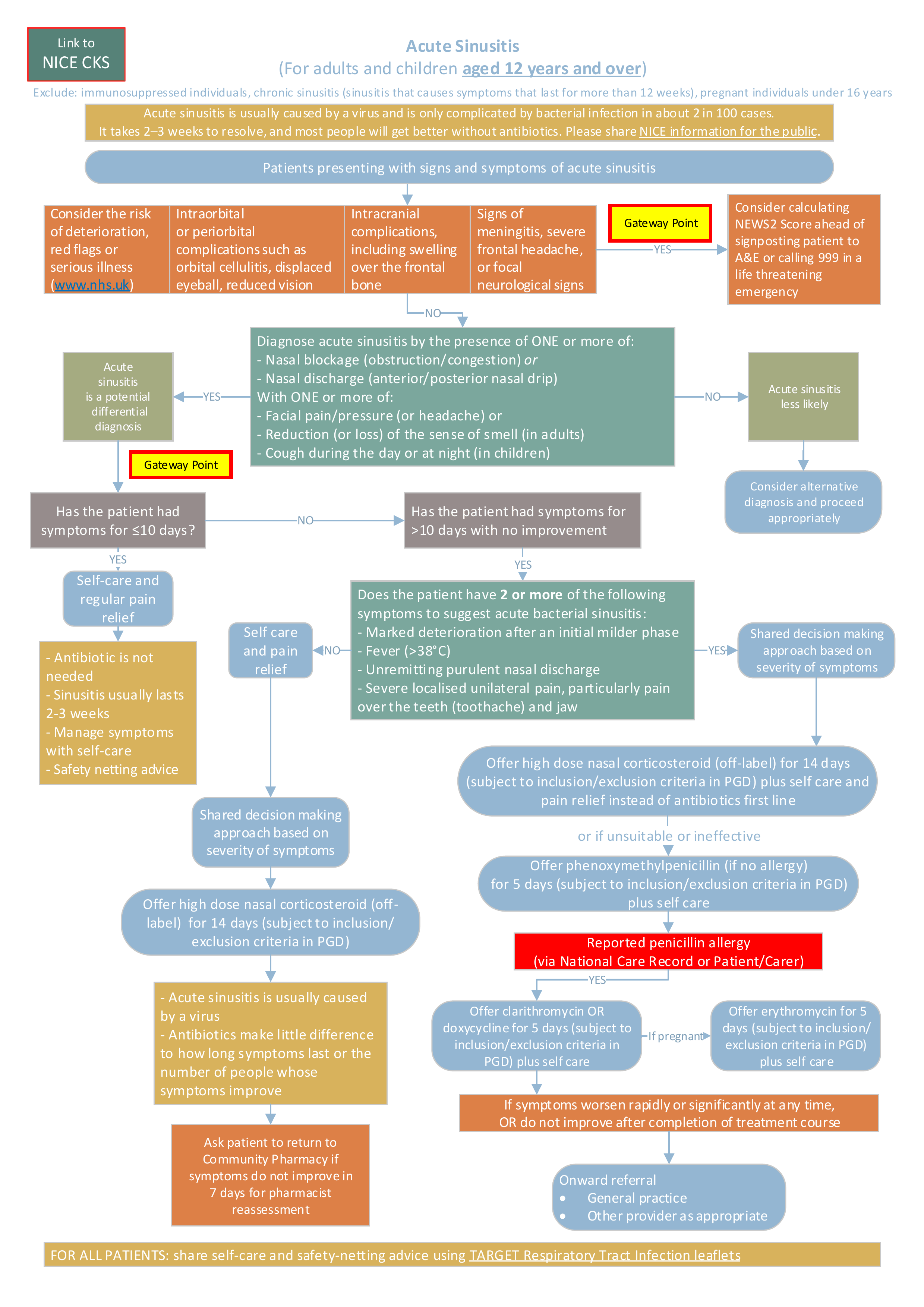
If the patient has passed the Gateway Point in the clinical pathway and has two or more of the following symptoms, this suggests acute bacterial sinusitis:
- Marked deterioration after an initial milder phase
- Fever (>38°C)
- Unremitting purulent nasal discharge
- Severe localised unilateral pain, particularly pain over the teeth (toothache) and jaw.
If a bacterial infection is NOT suspected, offer self-care advice and pain relief. Depending on the severity of the symptoms, consider offering a high dose nasal corticosteroid:
- Fluticasone — in children aged 12 years and over and adults
- Mometasone — in children aged 12 years and over and adults.
If a bacterial infection IS suggested, and based on the severity of symptoms, offer as a first option a high dose nasal corticosteroid. If this is unsuitable or ineffective there are four antibiotic options:
- Phenoxymethylpenicillin — for individuals aged 12 years and over
- Clarithromycin — for individuals aged 12 years and over with reported penicillin allergy
- Doxycycline — for individuals aged 12 years and over with reported penicillin allergy
- Erythromycin — for individuals aged 16 years and over who are pregnant, or where pregnancy is suspected, with reported penicillin allergy.
Check the patient meets the criteria for inclusion, then determine whether the patient might be excluded from treatment. General criteria for exclusion in all PGDs for acute sinusitis include:
- Individuals under 12 years of age
- Pregnancy or suspected pregnancy in individuals under 16 years of age
- Individuals who are immunosuppressed or are currently taking immunosuppressants (including systemic corticosteroids) or immune modulators
- Severely immunosuppressed individuals (as defined in Chapter 28a of the Green Book)
- Nasal trauma
- Epistaxis
- Foreign body inserted into nasal passage
- Recurrent sinusitis (four or more annual episodes of sinusitis without persistent symptoms in the intervening periods)
- Chronic sinusitis (sinusitis that causes symptoms that last for more than 12 weeks)
- Anatomic defect(s) causing nasal obstruction
- Comorbidities complicating management such as nasal polyps
- Individual has signs of a more serious illness or condition, i.e. red flag symptoms: intraorbital (within the eye) or periorbital (around the eye) complications such as oedema or cellulitis, displaced eyeball, double vision, ophthalmoplegia (paralysis/weakness of the eye muscles), or newly reduced visual acuity (reduced vision), intracranial complications such as swelling over the frontal bone, symptoms or signs of meningitis, severe frontal headache or focal neurological signs.
- Possible cancer:
- Unilateral (one sided) polyp or mass or bloody nasal discharge present
- Persistent unilateral symptoms, such as nasal obstruction, nasal discharge or nosebleeds, crusting or facial swelling
- Concurrent use of any interacting medicine.
For high dose nasal corticosteroids, additional criteria for exclusion are:
- Failed previous intranasal steroid for this episode of sinusitis
- Symptom duration less than 10 days
- Individuals with blurred vision or other visual disturbances
- Individuals with known or suspected glaucoma or raised intraocular pressure
- Individuals with untreated localised infection involving the nasal mucosa, such as herpes simplex
- Any individual identified with symptoms of severe/life-threatening infection or systemic sepsis
- Individuals currently taking oral, inhaled, topical or parenteral corticosteroids for any indication - to reduce the risk of adrenal insufficiency
For antibiotics, additional criteria for exclusion are:
- Known hypersensitivity to phenoxymethylpenicillin (penicillin-V)
- History of severe immediate hypersensitivity reaction (e.g. anaphylaxis) to another beta-lactam antibiotic
- Individuals following a ketogenic diet
- Failed previous antibiotic for this episode of sinusitis
- Suspected allergic or immunological cause of sinusitis
- Individuals currently taking/receiving medicines known to cause agranulocytosis (e.g. methotrexate, sulfasalazine, carbimazole, propylthiouracil, cotrimoxazole, valganciclovir, clozapine, carbamazepine, plus all chemotherapy). (Note - this does not apply to phenoxymethylpenicillin
- Known chronic kidney disease (CKD) stages 4 or 5 (eGFR <30ml/min/1.73m²)
- Less than 3 days before receiving, or within 3 days after receiving, oral typhoid vaccine.
Refer to the PGDs for a specific list of exclusions for:
- Fluticasone
- Mometasone
- Phenoxymethylpenicillin
- Clarithromycin
- Doxycycline
- Erythromycin.
All patients should be provided with the Treating Your Infection Respiratory Tract Infection (TYI-RTI) patient information leaflet (TARGET RTI leaflet).
Medicines that can be supplied, dose and frequency
| Medication | Dose and frequency |
| Duration of treatment — 14 days | |
|
Fluticasone furoate 27.5mcg/dose nasal spray Note: not licensed for the treatment of sinusitis but use for this indication and at this dose is supported by NICE guidance |
Two actuations (27.5mcg/actuation) in each nostril twice daily (total dose 110mcg twice daily) |
|
Mometasone furoate monohydrate 50mcg/dose nasal spray Notes: 1. ONLY the supply of the POM (and not the P medicine pack) is permitted 2. Not licensed for the treatment of sinusitis but use for this indication and at this dose is supported by NICE guidance |
Two actuations (50 mcg/actuation) in each nostril twice daily (total dose 200mcg twice daily) |
| Duration of treatment — five days | |
|
Phenoxymethylpenicillin 250mg tablets 125mg/5ml oral soln or susp x 100ml 250mg/5ml oral soln or susp x 100ml (or sugar-free alternatives) |
500mg four times a day |
|
Clarithromycin 250mg tablets 500mg tablets 125mg/5ml oral susp or soln x 70ml 250mg/5ml oral susp or soln x 70ml |
500mg twice daily (every 12 hours) |
|
Doxycycline 50mg caps 100mg caps 100mg dispersible tablets |
200mg as a single dose on the first day and then 100mg once daily for four days |
|
Erythromycin 250mg tablets 250mg gastro-resistant tablets 500mg tablets 125mg/5ml oral susp or soln x 100ml 250mg/5ml oral susp or soln x 100ml (or sugar-free alternatives) |
500mg four times a day |
Last reviewed: September, 2026
Next scheduled review: September, 2027

Share:


In Pharmacy First