



 25 Min
 In Learning

Follow this topic

Bookmark

Record learning outcomes
Learning objectives
After reading you should:
- Know the key stages of menopause transition and the range of symptoms experienced
- Be aware of the potential impact of fluctuating/declining hormones (oestrogen, progestogen, testosterone) on women's health, including future health
- Be familiar with some of the practical issues associated with hormone therapy
- Be able to explain the facts to counter menopause and hormone therapy misinformation
- Be aware of the need to provide additional lifestyle medicine support during the menopause transition
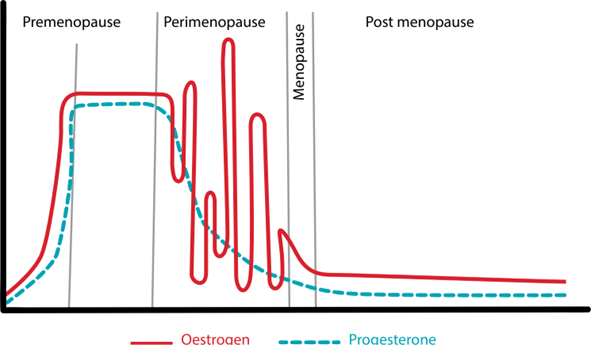
Oestradiol and progesterone are natural hormones produced by the ovaries, involved in the reproductive cycle. As women age these cycles become more erratic with hormone levels fluctuating (oestradiol) and declining (progesterone) with time due to reduced ovarian function (oocyte availability and ovulation) (see Figure 1).
Figure 1. Time to menopause and changes in oestrogen (oestradiol)/progesterone levels
Adapted from the Understanding menopause booklet (available at: https://menopausesupport.co.uk/wp-content/uploads/2025/07/Menopause-Support-Booklet-V2.pdf)
Key points
- Oestrogen receptors are located all over the body, with fluctuating/declining levels giving rise to a huge range of symptoms impacting physical and mental health, and relationships
- Hormone therapy needs to be individualised, with requirements changing over time and according to symptoms
- Hormone therapy is considered low risk when it includes the use of body identical hormones to restore physiological levels
- Optimal hormone and lifestyle management for women during peri- and post-menopause helps improve cardiovascular (CV), musculoskeletal (MSK), brain and genitourinary health
Follicle stimulating hormone (FSH) levels increase as ovarian function declines. Oestrogen receptors are located all over the body, so such low oestradiol levels can manifest in a wide variety of symptoms (see Table 1 below). Perimenopause and post-menopause symptoms vary in their nature, frequency, duration, timing, severity, and impact on quality of life (QoL).
| Table 1: Perimenopause and post menopause symptom checker | ||
|
Genitourinary and sexual Changes to periods
Vaginal/vulval changes*
Urinary*
Other symptoms
*Tend to worsen with time post menopause Vasomotor and sleep problems
|
Mental health, mood and cognition
Gastrointestinal
Metabolic
Immunological
|
Musculoskeletal
Cardiovascular
Skin and hair
Eyes and ears
Oral/dental
|
| Note: Symptoms may be due to other causes which need to be excluded | ||
Adapted from Symptom Checkers produced by: Menopause Support (https://menopausesupport.co.uk/) and Menopause Care https://www.menopausecare.co.uk/blog/symptom-checklist
Definitions
Menopause is the time when 12 months have elapsed since the final menstrual period (MP). Usually, it occurs from age 45 years, with early menopause being age 40-44. Premature menopause (premature ovarian insufficiency - POI) is when menopause occurs before age 40. The average age of menopause is age 51 (although this is earlier in some minority ethnic groups).
Perimenopause is the transition time leading up to menopause and is a turbulent time for many women due to hormonal changes. Due to its insidious nature, broad age-range and varied symptoms, women and clinicians may not associate their symptoms with changing hormone levels and menopause.
Post menopause is the time after the final MP, consequently the number of years women spend with low oestradiol and progesterone levels is increased in those with an earlier menopause. As lifespan is increasing, all women should be informed of the potential future health risks and be encouraged to take steps to optimise their current and future health.
Diagnosis
Hormone levels do not need to be checked to diagnose perimenopause/menopause in women aged 45 years and over. Fluctuating levels make measurements irrelevant and individualised care is based on taking an accurate history and the impact of symptoms on the individual.
Hormones, symptoms management and future health
It also protects bones, which means post-menopausal women have an increased risk of osteoporosis. Oestradiol is involved in osteoblast bone formation, so decreased levels negatively affect the balance between bone formation and breakdown. More than 1 in 3 post-menopausal women will have one or more osteoporotic fracture in their lifetime.
Oestradiol also plays a key role in vulval, vaginal and urinary health (genitourinary symptoms of menopause - GSM) with around 80% of post-menopausal women experiencing symptoms during their lifetime.
Additionally, oestradiol also has protective effects on the brain, so may reduce dementia risk as women age.
Starting hormone replacement therapy (HRT)
Choosing HRT should be kept simple in the first instance. Body identical hormones i.e. oestradiol and progesterone are preferred as they are structurally identical to the hormones naturally produced by the body.
While the term ‘bioidentical’ is also used, this includes unregulated, compounded hormones not tested for efficacy, safety and purity. The British Menopause Society (BMS) says bioidentical HRT can be “achieved using conventionally licensed products, without needing to use compounded varieties.”
Body identical hormones tend to be used first-line. Synthetic hormones are also available as patches, intrauterine system (IUS) and tablets (see Table 2 below).
| Table 2: HRT - Examples of body identical and synthetic hormones | ||||
| Oestrogen | Body identical hormone | Route of delivery (formulation) | Synthetic hormone | Route of delivery (formulation) |
| 17 Beta-oestradiol (estradiol) | TD (gel/patch/spray) Oral (tablet) vaginal (tablet) |
Conjugated oestrogens | Oral (tablet) | |
| Oestriol (estriol) | Vaginal (cream/gel/pessary) | |||
| Progestogen | Micronised progesterone | Oral (soft capsule) | Dydrogesterone | Oral (tablet) |
| Micronised progesterone | Vaginal (pessary) | Levonorgestrel (LNG) | Vaginal (IUS) | |
| Norethisterone | Oral (tablet) | |||
| Medroxyprogesterone | Oral (tablet) | |||
| Combined oestrogen/progestogen | oestradiol/progesterone (Bijuve) | Oral (soft capsule) | ||
Transdermal (TD) oestradiol is usually prescribed first-line as the risk of thrombotic effects is lower with this route. Oral oestradiol undergoes metabolism in the liver where clotting factors are produced.
A progestogen is also needed for women if they have a uterus and are on any oestrogen-containing HRT, as it is used to protect the lining of the uterus (endometrium). This is because oestrogen can cause endometrial proliferation and endometrial cancer. It is important that this is clearly explained to all women starting HRT. Note: the risk of endometrial cancer is increased in women with overweight or obesity, or diabetes (independent of HRT).
Most menopausal women, can use TD, body identical HRT containing oestradiol to help with their symptoms. If indicated, oral micronised progesterone (body identical) is commonly used.
Treatment regimens
Perimenopausal women (with a uterus) usually take their HRT sequentially i.e. an oestrogen-containing product for 28 days of their menstrual cycle and the progestogen-containing product on days 14-28 of their cycle. For example, 200mg micronised progesterone orally on days 14-28, which allows a monthly menstrual bleed.
Post menopausal women take their HRT continuously as oestradiol (plus progestogen if they have a uterus). For example, 100mg micronised progesterone every day, usually at night.
Women with a complex medical history e.g. CV disease, endometriosis, migraine, history of cancers need to discuss their options with a clinician with specialist menopause training.
Common problems with HRT
Breakthrough bleeding can happen in the first 3-6 months after starting HRT and after changing the dose or formulation, women should be reassured that this is not unusual. However, any post-menopausal unexpected bleeding after 6 months of continuous HRT needs to be investigated.
Women will need further assessment and an internal ultrasound. If there are no cancer findings, the endometrium is ≤ 4mm, and no additional risk factors the dose of micronised progesterone can be increased to 200mg at night (See Useful Resources for further information).
Other symptoms, such as mood changes, breast tenderness, or bloating may be improved by trying a different dose/route of oestradiol or switching the progestogen, if symptoms are severe or do not improve after at least 3 months. Micronised progesterone capsules are sometimes used intravaginally (off-licence) in those who cannot tolerate progesterone orally.
Oestradiol blood levels may need to be checked if the woman has tried different TD formulations (gels/patches/spray) at maximum doses and is still experiencing symptoms. The aim is to achieve physiological levels to help minimise symptoms and improve QoL.
Oestradiol levels should be between 250 picomol/L and 1000 picomol/L. Low oestradiol levels may be due to poor skin absorption, which can occur in about 25% of those using TD HRT. Some factors that affect absorption include site of application, skin temperature, hydration, and epidermal thickness.
Contraception and HRT
The College of Sexual & Reproductive Healthcare (CoSRH) states that women aged under 50 years should use contraception for two years after their final MP, and those aged over 50 need to use contraception for at least a year. The progestogen-only pill (POP) can be used with HRT but it does not give enough endometrial protection to be used as HRT. However, the IUS containing levonorgestrel can be used for both contraception and the progestogen part of HRT.
Managing GSM
Vaginal and bladder symptoms tend to worsen with time unless treated, impacting future health and wellbeing. Vaginal oestradiol/oestriol can be used and as systemic absorption is minimal there are few contraindications.
Some individuals (about 20%) may need both systemic HRT and vaginal oestrogen, if they have GSM despite optimal HRT. Tablets and creams should be used nightly for 2 weeks (3 weeks for pessary and gel) and then twice weekly as maintenance.
This can be continued long-term as symptoms frequently recur on stopping. Since absorption is minimal, progestogen is not required. Additional, non-hormonal lubricants and moisturisers can also be used.
| Important practical points about HRT | |||
| Formulation | Advantages | Disadvantages | Notes |
| Oestradiol patch |
|
|
|
| Oestradiol gel |
|
|
|
| Oestradiol spray |
|
|
|
| Micronised progesterone |
|
|
|
| IUS containing LNG |
Can be used for:
|
|
|
| Fixed combination patch/tablet |
|
|
|
Advice for women starting HRT
- Allow 3-6 months on treatment, and after dose or formulation changes to see if symptoms/adverse effects improve, unless intolerable
- Progesterone is needed to protect the lining of the uterus
- Report any unexpected bleeding after taking continuous HRT for over 6 months
- Take progesterone capsules at bed-time, ideally 2 hours after food. It has a sedative effect, so may help sleep
- Despite dose optimisation, TD oestradiol may not be effective in 25% of women due to absorption problems. Ask for a blood test to check oestradiol levels
- They may need a different dose/formulation to other women they know
- Individualised therapy can take many months to achieve success. Only change one thing at a time as more likely to know what might be helping
Testosterone the missing piece of the puzzle?
Testosterone is also a female hormone (about a tenth of the levels found in men) that declines with age, produced by the ovaries and adrenal glands. Even with oestradiol optimised, some women still experience symptoms.
Currently, RCT data are only available for use in reduced libido (hypoactive sexual desire Disorder - HSDD). Yet, observational studies also report women having improvements in energy, mood, brain function and MSK health.
A blood test is needed to check baseline levels, before starting treatment if levels are suboptimal in women with symptoms. Unfortunately, most licensed products are designed for men so need to be used at much lower doses. Testosterone can be prescribed through the NHS but depending on local formularies, specialist advice may be required e.g. GP with specialist interest consults with a hospital specialist.
| Testosterone replacement products*, doses and availability | |||||
| Product name | Route of delivery (formulation) | Dose | Product licence | How long a pack lasts | How to use |
| AndroFeme (imported) | TD (1% cream in a tube) | 5mg (0.5ml) once daily | Women HSDD | 100 days |
|
| AndroFeme (UK) | TD (1% cream in a pump) | 5mg (0.5ml) once daily | MHRA approved Women HSDD |
Pump pack expected in 2026 | |
| Testogel | TD (1% gel in a sachet) | 5mg (an eighth of a sachet) | Men | 8 days | |
| Tostran | TD (2% gel in a pump) | 10mg (one pump) on alternate days | Men | 240 days | |
| * Not currently covered by HRT PPC | |||||
Possible problems with testosterone
Side effects are primarily dose-related e.g. hair growth, voice changes, so it is important women know how to use the product prescribed and have blood tests (6-12 monthly) to check levels. Trough levels are measured, ideally the morning before the next application. Currently, free testosterone levels are measured, however some testosterone is bound to sex hormone binding globulin (SHBG). Percentage levels are reported as a free testosterone/SHBG ratio. As a guide, levels should be between 3-5%.
Healthy lifestyles and hormone changes
Every menopause is different which means each woman needs to be managed on a case-by-case basis according to their individual symptoms, concerns, lifestyle and cultural expectations.
The menopause transition can have a massive impact on women, as such a biopsychosocial approach which considers lifestyle is crucial. While many symptoms are due to changing hormone levels, they may be multifactorial and worsened by work, family/relationship pressures, stress, sleep problems, poor diet, alcohol and lack of exercise.
For those on HRT/unsure or able to have HRT, offer women practical lifestyle advice around the six pillars of lifestyle medicine: physical activity; healthy eating; minimising harmful substances/behaviour; better sleep; mental wellbeing; social connection. For some, HRT helps make some of these a little easier to try.
Misunderstandings and myths about HRT
HRT increases risks of developing breast cancer
Correction: Combined HRT for 5 years has a slightly higher risk of breast cancer. However, breast cancer risks are greater in post-menopausal women with obesity/ who drink 2 or more units of alcohol/day.
Women who have had blood clots/ with cardiovascular disease cannot have HRT
Correction: Some forms of HRT have a slightly higher risk of causing blood clots (venous thromboembolism - VTE) and are linked to risk CV events (stroke and heart attack). However, risks are higher in women with CV disease/who are over 60 years old and taking combined HRT. The first 10 years after menopause is the cardiovascular 'window of opportunity'. Body identical TD oestradiol and micronised progesterone are the preferred options if HRT is needed.
Women with overweight or obesity cannot have HRT
Correction: Overweight or obesity increases a woman's risk of a CV event and cancers. Body identical TD oestradiol and micronised progesterone are the preferred options if HRT is needed.
Smokers cannot have HRT
Correction: Smoking increases the risk of blood clots. Transdermal oestradiol is a suitable option as it is not metabolised by the liver where clotting factors are produced.
Women with a history / family history of cancer cannot have HRT
Correction: This is not completely true. Some women can have TD oestradiol (with a progestogen if needed) depending on their risks and type of cancer. Some women choose to have HRT after discussion with both their Menopause Specialist and cancer team, when menopause symptoms affect their QoL.
HRT causes weight gain
Fact: Weight gain is not caused by HRT itself. It is a symptom of menopause as low oestradiol levels increase central adipose tissue which secretes oestrone, a less potent oestrogen. This is further impacted by poor sleep and stress; lifestyle choices, including poor diet, alcohol and lack of exercise.
HRT delays menopause
Fact: Endogenous oestradiol/progesterone will still be fluctuating and declining in the background regardless of HRT.
HRT needs to be stopped once women reach their menopause/after age 55
Fact: Women can continue with HRT for as long as the benefits of symptom control and improvement in QoL outweigh any risk.
CPPE menopause workshops
CPPE is running a series of menopause workshops. The dates are as follows:
| Date | Location | Postcode |
| 12 August | Newport | PO30 2QR |
| 1 September | Solihull | B90 4JG |
| 7 September | Boldon | NE35 9PE |
| 10 September | Leeds | LS11 5DJ |
| 10 September | Borehamwood | WD6 5PU |
| 13 September | Hessle | HU4 7DY |
| 15 September | Kingston upon Thames | KT1 2EE |
| 15 September | Swindon | SN3 6AQ |
| 16 September | London (Russell Square) | WC1B 5BJ |
| 16 September | Hove | BN3 8EX |
| 17 September | Chelmsford | CM1 1SQ |
| 20 September | Newcastle under Lyme | ST5 4DL |
| 22 September | Ellesmere Port | CH65 2AL |
| 22 September | Beds | MK45 1AH |
| 23 September | Blackburn | BB5 5JP |
| 24 September | Eastbourne | BN22 9BH |
| 28 September | Diss | IP22 4LB |
| 29 September | Stockport | SK2 6EL |
For more information, see cppe.ac.uk/programmes/e/menopause-w-01.
Useful resources
- Menopause: Clinical Knowledge Summary May 2026
- British Menopause Society (BMS)
- Newson Education: Clinical Tools & References
- Women's Health Concern (patient arm of the BMS)
- Menopause Support

Share:


In Learning
This is your ultimate guide to pharmacy learning. Here you can find modules, articles, scenarios and more to improve your knowledge and support your learning in the pharmacy.