What is social prescribing? How the system works
What is social prescribing?
Social prescribing helps, connects, supports and works with people to meet their psychosocial needs by providing community-based support.
It helps to address the practical, emotional and social needs that affect patient health and wellbeing. The ‘social prescription’ offered to each patient will be different, depending on their needs and circumstances, with the degree of help and support offered based on what works best for that person. It can range from financial support and help with issues such as poor housing to coping with loneliness and promoting physical activity.
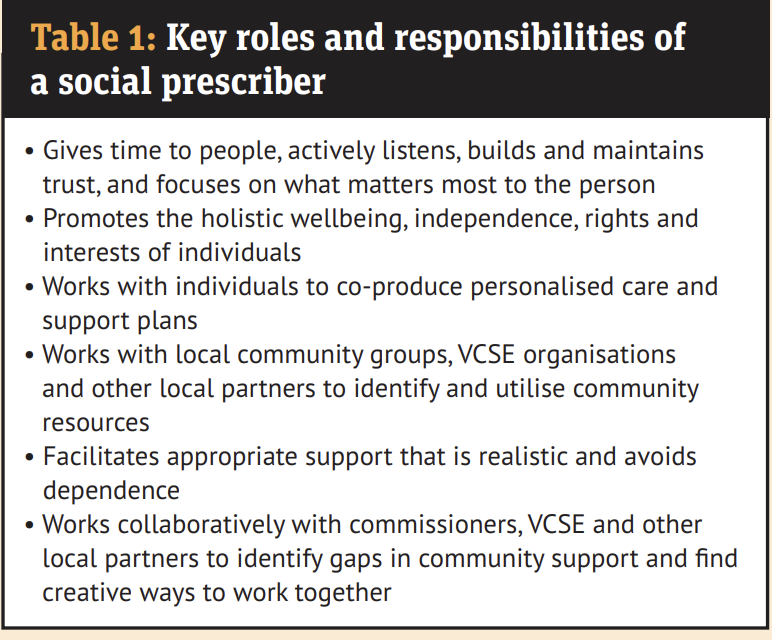
The key roles and responsibilities of a social prescriber are outlined in Table 1, below.
How the system works
Social prescribing link workers are now employed in the NHS. No specific qualifications are required although the NHS has produced guidance for the role. Once employed, mandatory training is completed, as well as specific e-learning programmes for link workers hosted by Health Education England and/or the Personalised Care Institute. Ongoing training is provided, allowing social prescribing link workers to map their knowledge and skills to a competency framework.
Initially, the social prescribing link worker receives a referral. Most originate from medical routes (i.e. GPs and other NHS services), but they can be made by almost anyone, from local authorities and VCSE organisations to job centres and social care services. Self-referral is possible in some areas.
There will be a face-to-face session at the person’s home, lasting at least an hour. The social prescribing link worker will establish what is important to the person by initiating a person-centred conversation based around asking ‘What matters to you’, using the model of personalised care (see Figure 3; next screen). A personalised care and support plan will be designed, covering what the person wants to achieve and how they will do it.
The link worker will work with the person over several sessions (typically six to 12 over a three-month period). After this, if the person feels they need more support, they can re-refer themselves back into the system.
A caseload of 200-250 people a year is recommended for social prescribing link workers, with one in five having a caseload of over 300.
A 2025 survey from the National Academy of Social Prescribing found that the most common social prescribing actions were connecting people with information and advice services, healthcare services, age-related groups (e.g. Age UK, youth organisations) and local physical activities. Depending on the needs of the patient, the link worker may signpost them to a care co-ordinator or a health and wellbeing coach (see Figure 4; next screen).