




 Older infants and toddlers
As babies start to receive complementary food at around 6 months, it is important they continue to receive good quality protein at an appropriate level. National dietary surveys show that in infants over 6 months, average daily protein intake exceeds recommendations and intakes of iron and vitamin D may be sub-optimal.14,15
The latest infant dietary survey shows that in the UK, 10-14% of infants aged 7-11 months have an iron intake less than the Lower Reference Nutrient Intake (LRNI).14
Iron needs are high from 6 months onwards16 and so SMA® PRO Follow-on Milk provides 58% of an infant's iron requirements, 63% of the calcium requirements and 86-100% of the vitamin D requirements, in a daily serving of 500ml.17,18
SMA® PRO Follow-on Milk - from 6 months
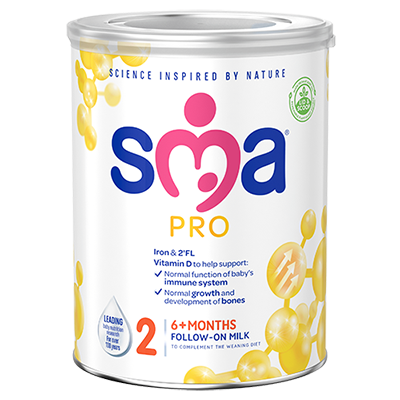
Appropriate growth
- The only Follow-on Milk in the UK & Ireland supported by clinical trials which demonstrated appropriate growth19,20
- The lowest protein follow-on milk in UK & Ireland21-24 – studies suggest that excessive protein in early life is linked with rapid growth and higher risk of later obesity25,26
Immunity
- Contains vitamin D which contributes to the normal functioning of baby’s immune system11
- Contains 2’FL Human Milk Oligosaccharide (HMO)*: Research suggests that infants fed an infant formula supplemented with 2’FL HMO* had immune markers closer to breast-fed infants12
(PIP code: 347-3915)
SMA® PRO Growing Up Milk - from 1 to 3 years
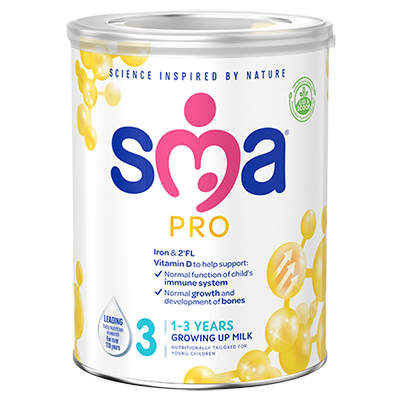
Appropriate growth
- The lowest protein growing up milk in UK & I27-31 – studies suggest that excessive protein in early life is linked with rapid growth and higher risk of later obesity25,26
- Omega 3&6† and iodine to help support normal growth
Immunity
- Contains vitamin D which contributes to the normal functioning of baby’s immune system11
- Contains 2’FL; the most abundant oligosaccharide found in human milk12
(PIP code: 347-4012)
*2'FL: structurally identical human milk oligosaccharides, not sourced from breast milk. † Beneficial effect of essential fatty acids is obtained with a daily intake of 10 g of linoleic acid and 2 g of α-linolenic acid.