



 1 Min
1 Min In Clinical

Follow this topic

Bookmark

Record learning outcomes
Objectives
After reading this feature you should:
- Understand the importance of the skin as barrier
- Be able to describe the normal skin healing process
- Be aware of the most common types of wounds
- Be able to offer advice on wound and scar management.
The skin is the largest organ in the body, accounting for roughly 15% of the total body weight. It provides an intact barrier to the outside world that protects against external physical or chemical hazards.
But the integrity of this barrier can be compromised by wounds or burns, increasing the risk of infection and dehydration. What’s more, after damage, the body’s recovery processes can sometimes go into overdrive, leading to scar formation.
Wounds
In healthy individuals, the skin is highly resilient with an incredible capacity for repair. Unfortunately, this facility for repairing wound damage is suboptimal for a significant proportion of the population.
Furthermore, the burden of wound care on the NHS is enormous, with one 2020 estimate suggesting that an estimated 3.8 million patients required treatment for their wounds at a cost of over £8 billion.
There are several different categories of wounds, ranging in severity. The primary causes and features are summarised in the Table 1 below.
Table 1: Different wounds and their features
| Type of wound | Primary causes | Extent of bleeding |
|---|---|---|
| Abrasion (scrapes) | Friction when the skin slides along an uneven surface, wearing away the epidermis. For example, slipping on gravel. | Generally minimal and the skin looks raw or grazed with oozing of fluid. As the skin heals a protective layer (scab) is formed. |
| Laceration (tears) | Blunt force trauma due to falls, blows, sharp objects or even animal/insect bites. | Bleeds more than an abrasion and may require stitching. Potential risk of infection. |
| Incision | Sharp object (e.g. glass, knife), slicing collagen fibres. | Can be quite heavy as blood vessels are severed. |
| Puncture | Deep but narrow and caused by needles, bites, glass etc. | Variable and dependent on affected area, e.g. higher on face. |
The healing process
Wound healing is a series of processes that repair and restore damaged skin, as shown in Figure 1 below. Wounds are classified as acute or chronic - the latter are defined as those that fail to progress through the normal healing stages and persist for more than four to six weeks.
Common reasons for the development of a chronic wound include:
- Poor circulation (e.g. due to peripheral artery disease)
- Venous insufficiency
- Diabetes
- Weakened immune function
- Nutritional status.
Figure 1
Blood vessel vasoconstriction
Platelet aggregation to form a clot
Neutrophils & monocytes recruitment
Destruction of bacteria & removal of debris
Regeneration of the wound area
Re-epithelialisation
Contraction of the wound margins
Creation of new collagen
increasing strength of wound area
Figure 1: Normal stages of wound healing
Wound management
Most of the acute wounds described in Table 1 (above) heal without any lasting damage if the necessary first-aid measures are adopted as soon as possible following the occurrence of the wound. However, if a wound becomes chronic, the ongoing management requires specialist assessment.
There are an enormous range of wound dressing products available, which can be a source of confusion. Several factors will influence the choice of dressing. These include:
- The nature of the wound
- The overall treatment goals (e.g. infection management, exudate management)
- The wound location
- Patient-related factors (such as self-care capacity, skin fragility, and pain levels
An individual dressing does not heal the wound, but instead creates an ideal environment for healing. In addition, the dressing type may need to be changed as the wound progresses through the healing stages.
An overview of some of the different wound management dressings and the wound features for which each dressing is most appropriate is summarised in Table 2 below.
Table 2: Commonly used wound management dressings
| Type of dressing | Suitable wounds | Comments |
|---|---|---|
| Film (e.g. Tegaderm) |
Superficial/acute wounds with low amounts of exudate | Film dressings are non‑absorbent and inappropriate for those with fragile skin such as the elderly. |
| Foam (e.g. Allevyn) |
Best suited to wounds with low to moderate exudate | Foam dressings offer a cushioning effect and can be both adherent and non‑adherent. |
| Alginate (e.g. Sorbsan) |
Wounds with a moderate to high level of exudate | Once in contact with the wound, the alginate absorbs exudate and forms a gel. A secondary overlying film or foam adhesive dressing is also required. |
| Carboxymethylcellulose (e.g. Aquacel) |
Best for minor abrasions/post‑operative wounds with low to moderate exudate | Absorbs wound fluid, removes bacteria and debris, and prevents maceration. Like alginates, forms a gel and requires a secondary dressing. |
| Hydrogels (e.g. Intrasite Gel) |
Dry wounds with large amounts of non‑viable tissue | A hydrogel donates water to the wound to support debridement of dead tissue. |
| Hydrocolloids (e.g. Duoderm) |
Non‑infected wounds with minimal exudate; mildly exuding wounds | Forms a moist gel in contact with exudate to soften sloughy tissue and maintain moisture to promote granulation. Flexible and suited to difficult‑to‑dress areas such as elbows, heels, or knees. |
| Antimicrobial (e.g. Aquacel Ag, Medihoney) |
Either infected wounds or wounds at high risk of infection | Typically, the dressing is impregnated with the antimicrobial, which is released into the wound or acts on bacteria after absorption. Examples: medical‑grade honey, silver, and iodine dressings. |
Burns
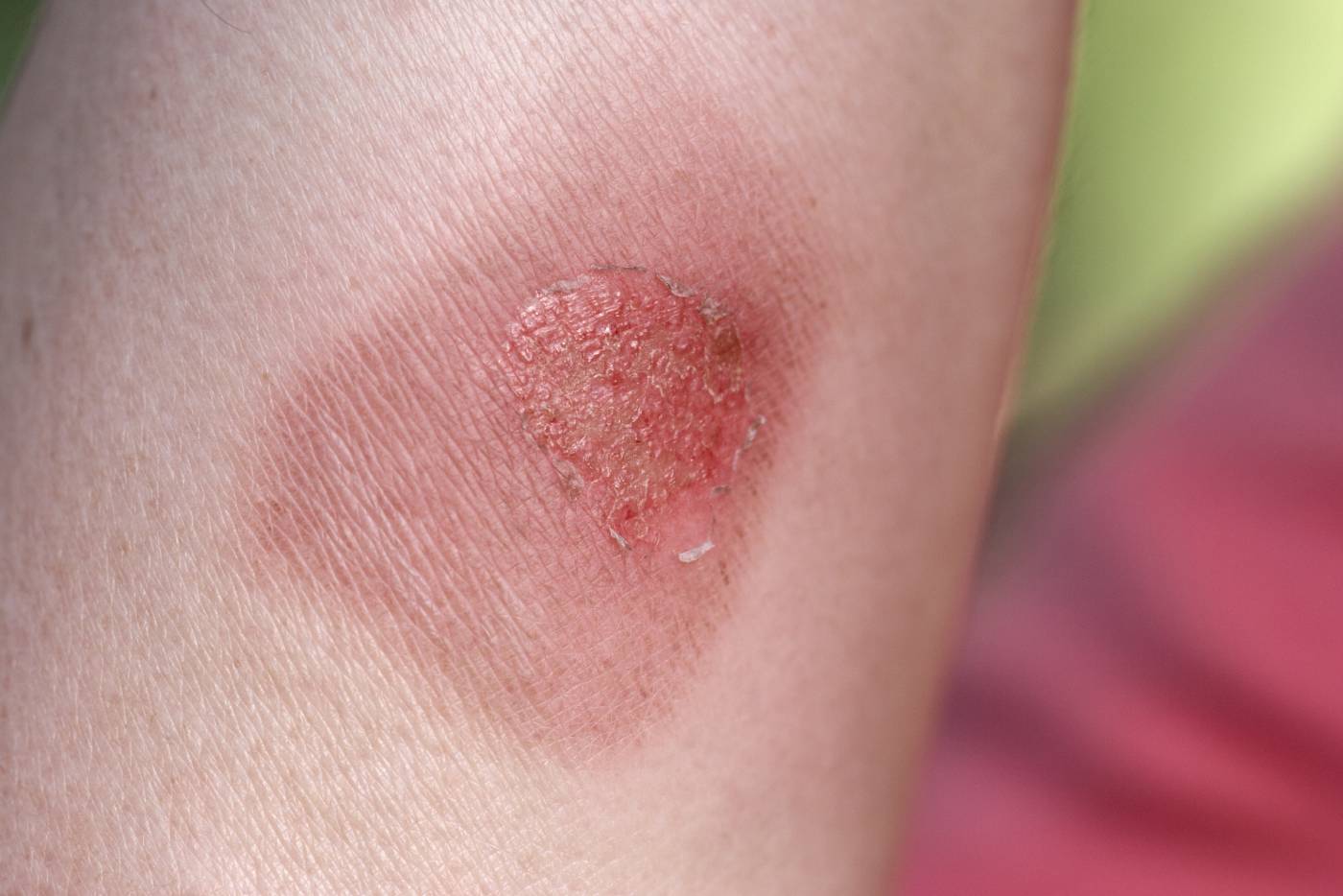
Skin damage from a burn occurs after contact with a heat source. The most common type of burn is a thermal injury, although a small proportion is due to electricity and chemicals.
The term ‘scald’ is also commonly used to indicate a burn that arises from contact with hot liquid or steam.
Burns vary in severity from superficial (affecting only the epidermis), partial thickness (in which the outer part of the dermis is affected), through to full thickness, in which all layers of the skin are affected.
Management of burns
First-degree and small superficial partial-thickness burns can be managed by pharmacy teams. However, any burns or scalds exceeding 10 cm in size, or with severe blistering or skin discolouration, should be referred.
For smaller, thermal burns, appropriate first-aid measures include:
- Removal of non-adherent clothing and potentially restricting jewellery
- Irrigation of the area within 20 minutes with cool or tepid running water for 15–30 minutes to stop the burning. Ice or very cold water should be avoided, as this can induce vasoconstriction and may deepen the wound
- Intact blisters should not be burst, and the burn area should be cleaned with saline or water
- Following cooling, if patients are going to hospital, the burn should be covered with cling film or a clean cotton sheet.
Any associated pain can be managed with simple analgesics such as paracetamol or ibuprofen.
Scars
The development of a scar represents ‘over-healing’ by the skin due to increased collagen production. There are several types of scars, including atrophic scars with a sunken or pitted appearance, contracture scars that can limit mobility, and striae (stretch marks).
By far the most common are hypertrophic and keloid scars. Hypertrophic scars develop within the boundary of the damaged skin and typically form within the first month after injury.
Little is known about the underlying cause of these scars, although both genetic and environmental factors have been implicated. Fortunately, hypertrophic scars often significantly improve over a period of one to two years.
On the other hand, keloid scars develop and extend beyond the original wound margin, continuing to grow over time. Keloids can arise from any type of skin injury (e.g. scratches, insect bites, or body piercing).
Management of scars
One of the most recognised treatments for scars involves silicone gel or silicone sheets, which appear to be effective. Despite its widespread use, there is little strong evidence supporting the use of silicone gel for the treatment of hypertrophic or keloid scarring.
Other topical therapies involving aloe vera, green tea and onion extract do appear to have some supporting evidence.
Role of pharmacy teams
Pharmacy teams have always played an important role in managing acute wounds. However, as noted earlier, chronic wound management is highly expensive, and pharmacists could take a more proactive role in preventing the progression of chronic wounds.
Nevertheless, work from Australia suggests a current lack of knowledge among pharmacy staff about dressing wounds, including identifying dressing properties, dressing frequency, and selecting an appropriate dressing.
While it is unnecessary to train pharmacy staff to become experts in wound management, what matters is that teams can reliably recognise key wound types, identify red flags, and know the first steps to take. In fact, timely escalation is one of the most critical elements of effective wound care and is associated with faster healing.
But basic wound management training is not about shifting care due to an ever-increasing workload. Rather, such training is designed to ensure that patients receive appropriate wound care advice aligned to the evidence base.

Share:


In Clinical
Let’s get clinical. Follow the links below to find out more about the latest clinical insight in community pharmacy.