





 4 Min
In Clinical

Follow this topic

Bookmark

Record learning outcomes
A man in his mid-forties walks into a community pharmacy and asks for a blood pressure check. It is the second week of the foundation year for trainee pharmacist Sam, and his designated supervisor is watching.
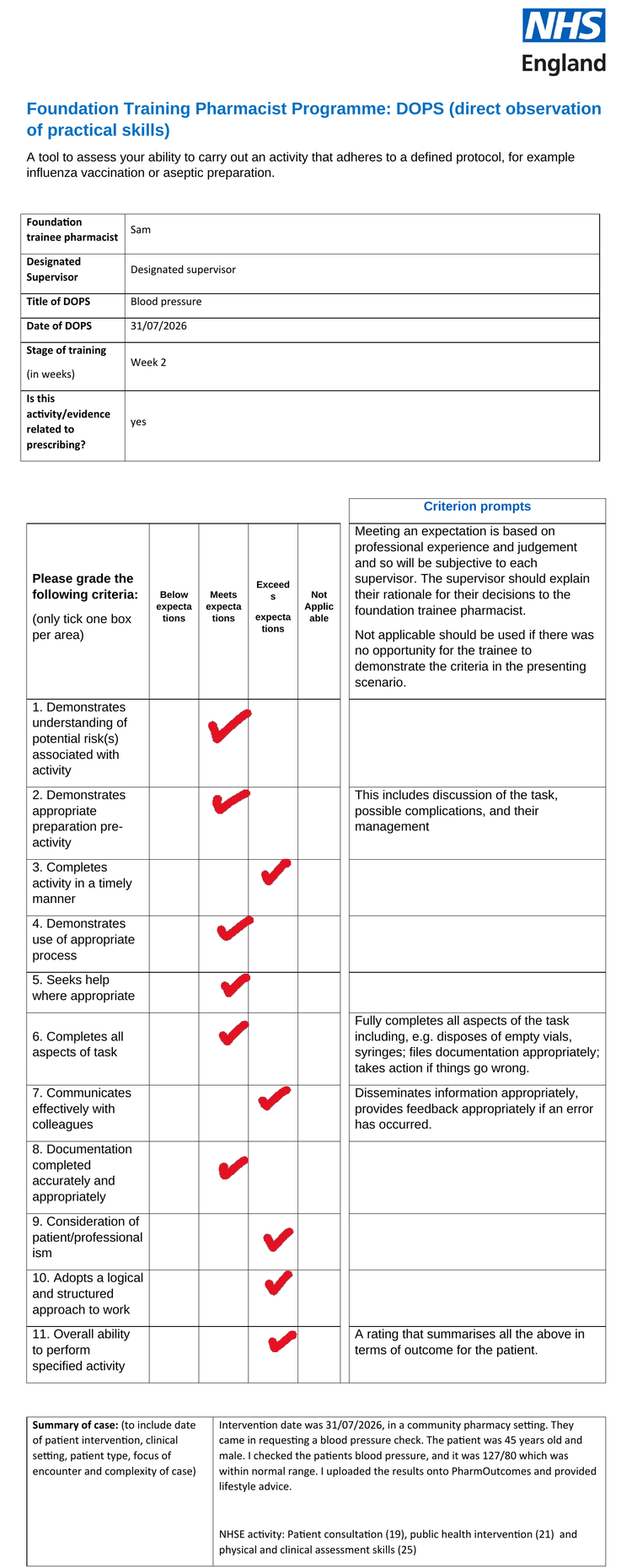
Sam seats the patient in the consultation room with his arm resting on a table. He avoids jargon and keeps things friendly. He takes three readings, and the result is 127/80 mmHg, within the normal range. He records it on PharmOutcomes and gives lifestyle advice.
Sam has done well, but the supervisor, completing the trainee’s DOPS (direct observation of practical skills) assessment, still has suggestions.
What is a DOPS?
A DOPS is a short assessment in which a supervisor watches a trainee carry out a practical task and grades how they did it. The foundation trainee pharmacist programme describes it as a tool to assess your ability to carry out an activity that follows a defined protocol, such as flu vaccination or entering a controlled drug into the CD register. Taking a blood pressure reading is another good fit.
The supervisor grades 11 criteria as below expectations, meets expectations, exceeds expectations or not applicable. The form also records the trainee’s stage of training in weeks, whether the activity relates to prescribing, and a summary of the case: the date, clinical setting, patient type, focus and complexity. The supervisor notes what went well and any suggestions for development.
The two agree an action, the trainee writes a reflection, and the supervisor (and, where relevant, a designated prescribing practitioner) add comments. The form is a record of that conversation.
Feedback and actions
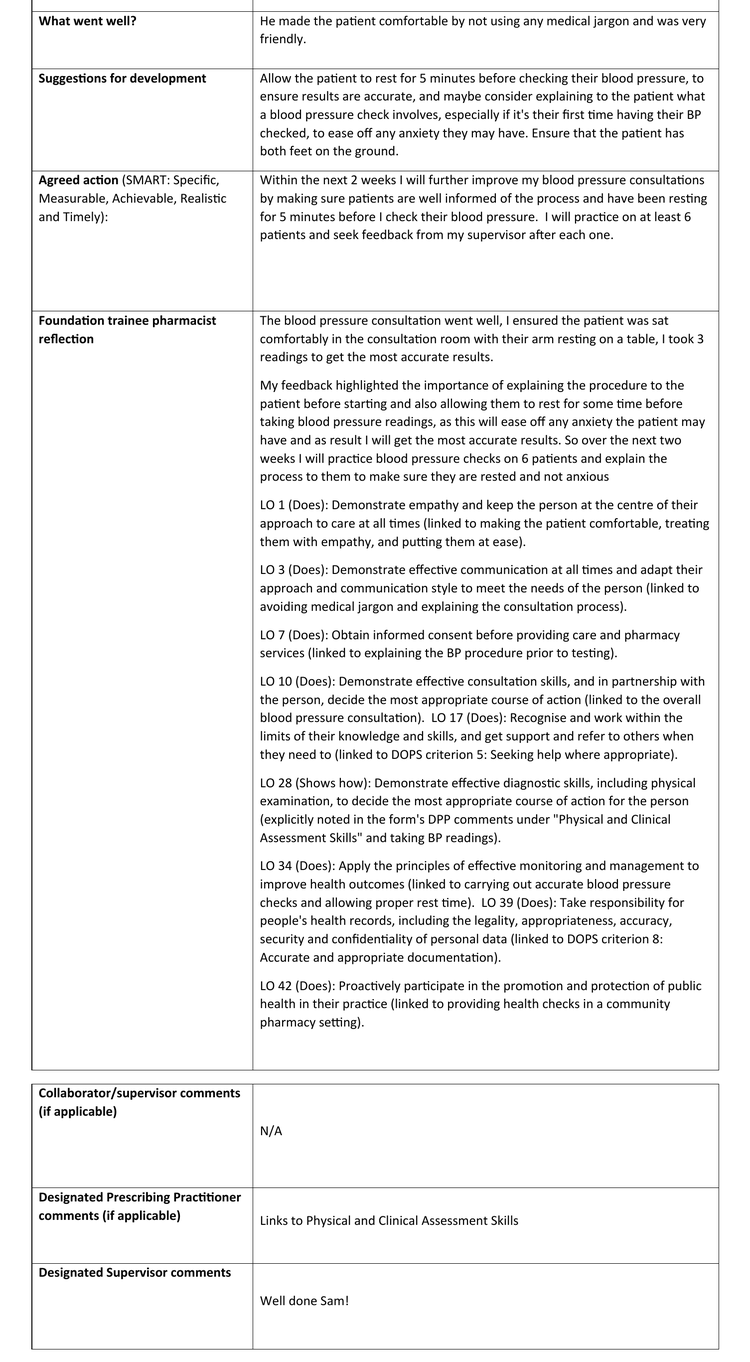
The supervisor praised Sam’s manner. He made the patient comfortable, avoided medical jargon and was very friendly. That is easy to overlook in a technical task, yet the form has a criterion for consideration of the patient and professionalism.
The development points were practical:
- Allow the patient to rest for five minutes before the check so the result is accurate
- Consider explaining what a blood pressure check involves, especially for a first-timer
- Make sure the patient has both feet on the ground.
A useful DOPS ends with an agreed action, and the form asks for one that is specific, measurable, achievable, realistic and timed. Sam was asked to improve over the next two weeks by making sure patients are well informed and have rested for five minutes. He is to practise on at least six patients and ask his supervisor for feedback after each one.
His own reflections were similar to the supervisor’s feedback.
Tips for trainees
A DOPS is about learning as much as grading, and Sam’s case suggests five habits.
- Prepare before you are observed. Discuss the task, its possible complications and how to manage them with your supervisor. That is a DOPS criterion in its own right.
- Ask why. The form asks supervisors to explain their reasoning for each grade, so ask for it if they don’t.
- Keep the case summary factual. Record the date, setting, patient type, what the encounter was for and how complex it was. Sam’s covered a community pharmacy, a 45-year-old man asking for a blood pressure check, a reading of 127/80 mmHg that he recorded, and lifestyle advice.
- Turn feedback into a measurable action. “Practise on at least six patients over two weeks and ask for feedback after each” is easy to check later. “Do better” is not.
- Reflect in your own words. Say what you learned and what you will change, and note the learning outcomes and NHS England activities the case covered, as Sam did (patient consultation, public health intervention, and physical and clinical assessment skills).
For supervisors
A useful DOPS depends on what the supervisor says, not on the tick boxes. Explain the reasoning behind each grade, as the form asks. Name what the trainee did well specifically, as Sam’s supervisor did. Keep development points to one to three that the trainee can act on, and agree one measurable action with a date. Then make sure the follow-up happens: Sam’s plan asks for feedback after each of six practice checks, which only works if the supervisor is available for them.
See the example of the completed form below for Sam’s activity.
For more learning, see the Pharmacy Magazine CPD module on Identification and management of hypertension
|
||||||||

Share:


In Clinical
Let’s get clinical. Follow the links below to find out more about the latest clinical insight in community pharmacy.