




 1.4 Effective interventions
1.4 Effective interventions
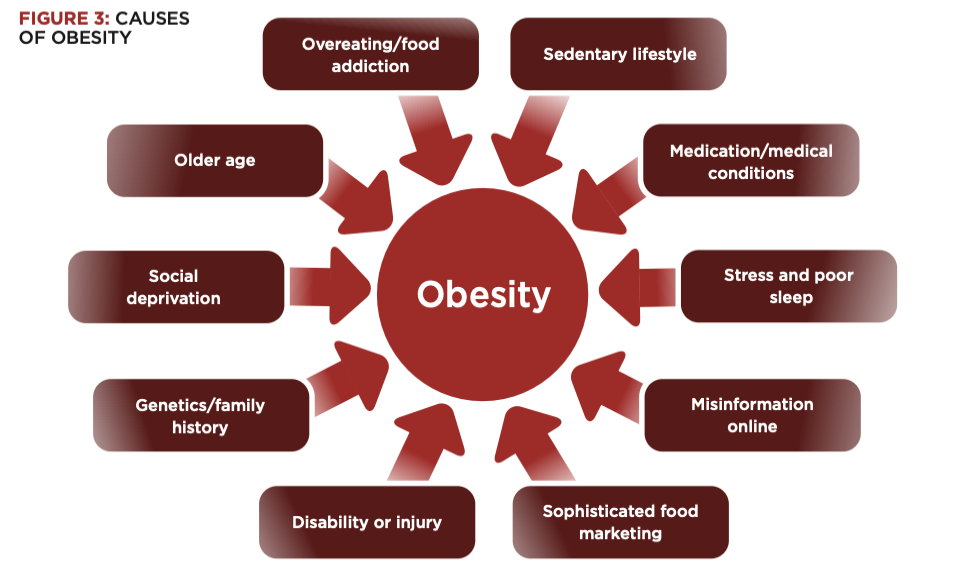
The contributors to weight gain are a complex interplay that goes far beyond the “unhealthy choices” stereotype and includes socioeconomic context and trauma among other factors. Research has identified how biopsychosocial (BPS) factors influence behaviour and there is an evidence base for both clinical and BPS aspects of weight management.
Dietary change and physical activity
The need for balance between the amount of energy (calories) consumed and the amount used means that it does not take a big discrepancy to result in gradual weight gain (or loss) over time.
Moving that discrepancy in the direction of weight loss involves changes in nutrition and physical activity and sustaining them. Starting where the person is at is crucial, as is recognising that the road ahead is likely to have a few twists and turns.
Eating a healthy diet with fewer calories is most likely to be achieved when tailored to what is realistic and acceptable, taking into account individual circumstances. For example, healthy food may cost as much as 2-3 times more calorie for calorie than less healthy foods. A food diary is a useful tool for suggesting food swaps and other changes.
Tailoring of advice on physical activity is also needed, again starting at where the person is at and what they are willing and able to try. People who are overweight or obese can find the thought of increasing their physical activity intimidating and potentially embarrassing.
Empathy and being non-judgemental are essential in helping someone find an activity that they can start with.
In Toolkit 5 we will go into more detail about how to individualise advice and start where the person is at.
Medicines
This training covers orlistat and GLP-1 drugs, licensed for use in weight loss and with a recognised evidence base to support their use. A brief resume is in this section with more detailed information in Toolkit 3 on pharmacological interventions as well as the SPC and PIL for individual products.
Orlistat
Over-the-counter orlistat is available as 60mg capsules and a POM version is 120mg capsules. Orlistat inhibits gastric lipases so that 25-30% less fat is digested and absorbed, and more fat is excreted in the faeces. It needs to be taken with or at most an hour after a main meal. If a main meal is very low in fat a dose is not needed.
OTC orlistat is for use by over-18s whose BMI is 28 or greater, and in conjunction with a low fat reduced calorie diet (500-800 calories less per day) and regular exercise. The POM licence is for use in obesity (BMI 30 or higher), or overweight (BMI 28 or higher) with associated risk factors such as type 2 diabetes, hypertension or hypercholesterolaemia.
Orlistat reduces the absorption of fat-soluble vitamins so a multivitamin supplement is advised. GI adverse effects are common (e.g. oily spotting, abdominal discomfort, increased flatulence, faecal urgency, fatty stools).
Not only eating less fat, but also spreading fat intake across meals is important to control GI effects. Taking loperamide will not control them. They usually reduce over time with continued use of orlistat.
GLP-1s
The glucagon-like peptide-1 receptor agonists (GLP-1RAs, sometimes referred to as GLP-1s) include semaglutide, liraglutide and the dual glucagon-like peptide-1/glucose-dependent insulinotropic peptide (dual incretin) agonist tirzepatide.
Initially licensed and used to treat type 2 (T2) diabetes, they regulate insulin secretion, appetite and the feeling of being full (satiety) by imitating the action of the gut hormones known as incretins. Their effects make people feel fuller and they delay gastric emptying.
Use of GLP-1s can lead to muscle loss alongside fat loss and there are important implications for both diet and physical activity to deal with this. GI adverse effects such as nausea, vomiting and diarrhoea are common. Most are mild to moderate or short in duration.
Although uncommon, pancreatitis (inflammation of the pancreas) has been reported and can be serious. The main symptom is severe pain in the stomach radiating to the back. Rarely, vision problems may occur.
Trials in people with obesity and heart disease have demonstrated improved health outcomes including reduced mortality and the body of evidence is increasing.
Specific preparations of semaglutide (Wegovy) and tirzepatide (Mounjaro) are currently licensed for the treatment of individuals with obesity and for people who are overweight with related health conditions. They are delivered as a subcutaneous injection using a pre-filled injection pen for weekly injections.
Products supplied as a powder in vials which must be mixed with a liquid prior to injection are not authorised and pose significant health risks. There have also been reports of counterfeit pre-filled pens that look almost like the real thing.
In July 2026, a semaglutide pill (Wegovy) was introduced to the UK. This was shortly followed by an oral version of a new GLP-1, orforglipron (Foundayo), in August.