




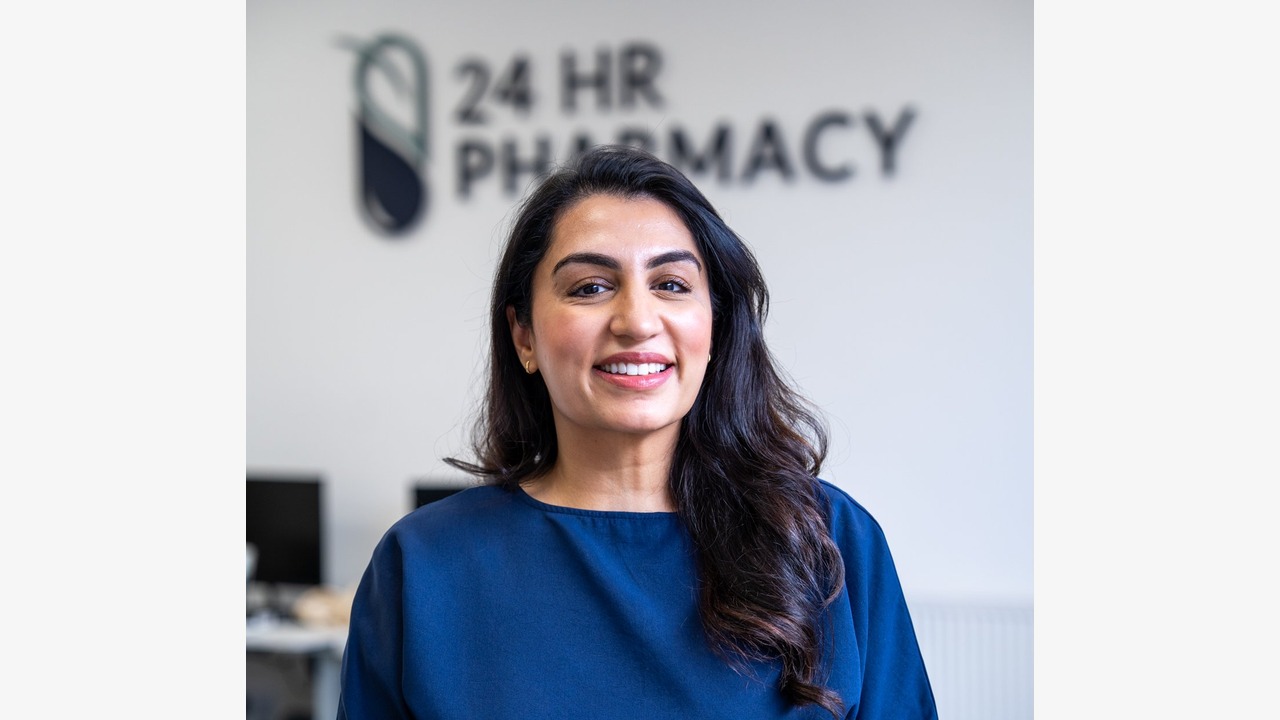
 9 Min
In Prescribing hub

Follow this topic

Bookmark

Record learning outcomes
Building trust online
| Qualified as prescriber: 2021 |
| Prescribing experience: 5 years |
| Professional memberships: Royal College of Pharmacy |
| Balance between NHS and private services: 100% private |
Do you have a special area of interest?
I completed my prescribing qualification with a focus on mental health.
Have you expanded your scope of practice?
Yes, I moved very quickly into obesity, which is what I have been doing for the past four or five years. Women’s health is another area, as well as minor illnesses. Because we have an online pharmacy, we cover around 30 different conditions in total across women’s health, men’s health, general health, skin and sexual health.
How did you go about that?
Having a business that caters for many conditions forced me to expand my scope of practice quite quickly. It is about making sure you fully understand the guidance, have completed your training, recorded CPD and, more importantly, had good-quality peer discussions.
That helps a lot because, as a prescriber, you are often working in isolation. So it is about making sure you have access to good peer support, such as a multidisciplinary team, although I know that can be difficult for pharmacist prescribers working in community pharmacy.
I always learn a lot from conversations with other prescribers because, although the guidance is the same, everyone’s practice is different -- and everyone’s risk appetite is slightly different too. You should always prescribe within your scope of practice, but remember that someone else’s scope for the same condition may look different, depending on their risk appetite. It is about broadening your mindset by listening to, and sharing with, other people.
What practical steps did you take to expand your scope of practice?
Let’s take obesity as an example. First, I completed accredited training courses on the condition and the relevant medicines used to treat it, followed by accredited scope training that is well recognised in the obesity management field.
I also trained directly with pharmaceutical companies to understand their products and the clinical studies behind them in more detail. That helped a lot, because I was able to access medical doctors who had been part of the research programmes and who understood obesity in some depth.
I have also completed courses and webinars on nutrition, as that is part of obesity care too. It is about doing as much relevant learning as you can, then writing up your CPD and reflections so you can identify any gaps in your knowledge.
For me, the biggest learning came from patients. I set up a weight loss clinic for another online pharmacy a few years ago, and we grew it slowly rather than taking on a hundred patients at once.
Patients would ask questions that I did not know the answer to, but it is okay to say: “I’m not sure; I’ll come back to you.” That gave me the opportunity to find the information, whether by going back to the manufacturer if it was a question about their medicine, or by speaking to a doctor who was more qualified or experienced. That helped me fill gaps in my knowledge and also fine-tune my scope of practice.
The patient experience builds on your foundation: understanding the condition, the medicines and the guidance. Clinical governance is just as much a part of that foundation, including understanding what safety netting means and how to do it properly. At what point does the patient need to see their GP? What are the red flag symptoms?
It is the same with your notes: stating “medicine approved” is not enough on its own -- you have to be able to justify your decision. I always tell other prescribers that their notes need to be good enough to stand up in court as evidence for why they made a particular decision. I can be pedantic about this. I know detailed notes can sometimes feel tedious, but they matter. As my business scales up, other prescribers need to see what conversations I have had with a patient so they can make the best decision about the next supply.
| “Stating ‘medicine approved’ in your notes is not enough on its own -- you have to be able to justify your decision” |
Basic notes will not give the patient the best care, so good clinical governance is a key part of your foundation too. Your scope then starts to grow through experience, particularly from speaking with patients.
How do you find the time to do all this?
You might think it is easier providing only private services, but there are different challenges. With an online private pharmacy, I spend a lot of time on marketing and content creation, which you would not necessarily have to do in an NHS pharmacy.
You also have to be fully compliant with MHRA and ASA advertising regulations. I am also dealing with a website development team, a tech team, a content creator and a marketing team running Google and Meta ads, because the whole business runs on technology.
| “The whole of my business runs on technology” |
So, although in some ways it is easier because I do not have a bundle of scripts landing at 9am with patients rushing in, there are still different challenges. What I am grateful for is that I can control much of it: when I have meetings with the marketing team, when I shoot content, and so on. So there is more control, but I would not say it is necessarily easier -- it is just different.
What are the risks involved in providing the services you offer?
We carry out risk assessments across every element of the business: for having a website, delivering medicines through a third-party courier and for each condition we treat, whether that is obesity, men’s health, sexual health or women’s health.
There are risks around all of these, but the key is building a long-term, safe and sustainable business through good governance. If you get that foundation right, you can scale exponentially. If it is not strong, the cracks will show, and you cannot scale a business with cracks in it.
Even when you risk-assess well, it does not mean nothing can ever go wrong. The risk will never be zero in any business. What matters is that you have mitigated it as far as possible, and that is what we do.
On top of that, we carry out audits every quarter, looking at incident reports and spot-checking notes to see whether they are good enough and cover all the relevant points whether things were approved within the licensing, and whether we were prescribing within protocols. That gives us the opportunity to update SOPs or processes where something falls short.
That is what good clinical governance is. It is not an exercise you do once and forget, but a process of continual improvement. It relates back to scope of practice too: you do not just complete your training once and then stop. I am constantly learning more about obesity.
Do you get feedback from patients on the services you provide?
Yes, mainly through Trustpilot, where we get lots of good reviews. They have all been five stars apart from one from a gentleman who I had to refer to his GP rather than treat for a UTI. I phoned him and explained everything, but you can’t keep everyone happy. If people want to give me a one-star review because I was trying to keep them safe, so be it.
The common theme across the other reviews is the support patients get through the weight loss service: we take the time to listen, we’re always there for them, the service runs smoothly and their medication arrives on time. That consistency is exactly what we aim for.
When I set this business up, I was drawing on having worked in community pharmacy throughout my career. Your community pharmacist knows you by name, while the staff behind the counter know your kids’ names -- there is a relationship and trust built up from always going to your local pharmacy.
Online is different because patients don’t necessarily stick with the same pharmacy; they will shop around for convenience or price. I wanted to create that same relationship online, so that patients would only ever want to come back to me.
I believe we’ve achieved that -- we have a 95% retention rate among our weight loss patients in a market that is otherwise very price-driven. We kept our customers even after a price increase last year. Nobody left for something cheaper because we explained things properly and looked after them.
Given that most online pharmacies lose up to 50% of customers after the first month, a 95% retention rate is huge and I’m really proud of it. I believe it comes down to the quality of the patient relationship -- all my weight loss patients know me by name, and I don’t know another online pharmacy that could say the same.
| “All my weight loss patients know me by name. I don’t know another online pharmacy that could say the same” |
How professionally rewarding do you find offering the service?
Enormously so. I’ve genuinely been in tears on video or phone calls with patients. One in particular had lost about 40kg with me over 12 months. He emailed me his latest blood test results, then phoned me straight away to make sure I’d checked them -- he was so excited.
His HbA1c, which had put him borderline diabetic, had come right down. His blood pressure was so well controlled that the nurse was able to stop two of his blood pressure medications, and we were able to bring down a high dose of venlafaxine he’d been on because as his physical health improved, his mental health improved with it.
His relationship with his wife improved too, since he’d been struggling with ED. He had so much more confidence -- and he was so motivated to share his results because it was concrete proof of the progress he had made.
That is what makes it so rewarding. With obesity, it isn’t about how a person’s clothes fit or what the scales say -- it is that you are literally adding years to someone’s life. When a BMI is over 40, a person can lose eight to 10 years of life expectancy. So I get to play a small part in helping someone to live longer and healthier. What could be more rewarding than that?
What about peer support?
I have a newly-qualified pharmacist who has just started with us. We also have another pharmacist, who is a regular locum for when I need cover. She is a really experienced pharmacist, especially in obesity, and she has worked in other online remote settings.
I also work for another online pharmacy as its head of clinical governance and prescribing, so look after around 10 prescribers in total. They send all their escalations to me, the complex clinical queries, but I learn so much from them. It is more of a culture where we all learn from each other.
What advice would you give someone starting out as a pharmacist prescriber?
Find yourself a mentor. I know that is not always easy, but it does not have to be anything formal. Plug into a community of practice or shadow someone, especially at the start, and be a sponge for learning.
Learn from someone working in an area you genuinely enjoy. You will enjoy it more and be better for your patients as a result. Prescribing and medicines are only one part of it; as pharmacists we can do much more to improve the service and experience for patients. So do something you are passionate about -- that is really important.
Always ask for help if you need to. There is nothing wrong with asking questions and learning. Even after five years, and training clinicians across the UK, I do not know everything and I am still learning. I see teaching others as a privilege, and I learn just as much from the questions they ask me. So be committed to learning all the time -- that is the key thing.
Finally, always hold yourself to a good standard, regardless of what anyone else is doing. It doesn’t matter if someone else thinks writing “approved” in their notes is fine, for instance -- what is your standard? Make sure it is as high as possible.
| If you would like to share your experience of being an independent prescriber, email: pm@1530.com |

Share:


In Prescribing hub