



 7 Min
7 Min In Practice

Follow this topic

Bookmark

Record learning outcomes
As summer approaches, most pharmacy customers will be planning their well-earned breaks. At the same time, private travel health services in pharmacy are expanding rapidly. From vaccinations to practical health advice while away, pharmacy teams are well placed to ensure that travellers are fully prepared.
Insurance non-negotiable
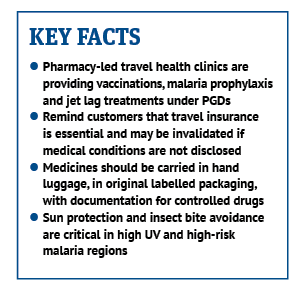
Adequate travel insurance remains a non-negotiable. It provides cover for pre-travel illness, emergency returns and personal liability. Patients must declare existing medical conditions and planned high-risk activities such as skiing or scuba diving, or risk invalidating their policy.
Alongside insurance, a Global Health Insurance Card (GHIC) gives access to state healthcare in certain countries. Patients should also check Foreign Office advice before travel – failure to follow official guidance can invalidate insurance.
Taking medicines abroad
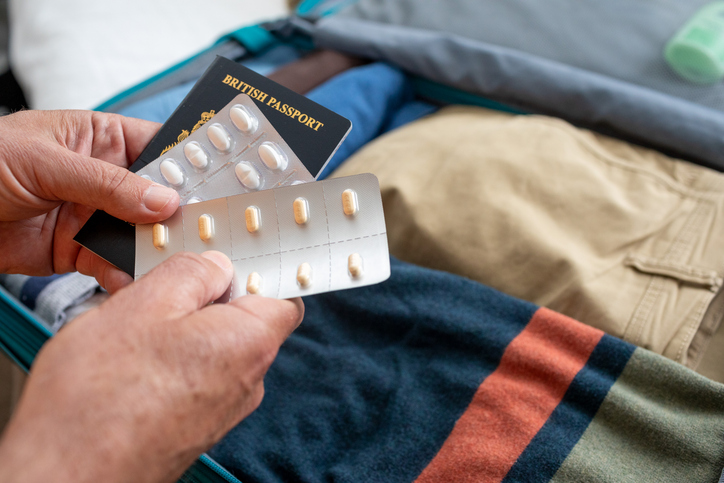
Patients should be advised to carry sufficient medication for the trip, plus extra in case of delays or loss. All medicines should be kept in hand luggage in original, labelled containers, with spare supplies in checked luggage.
Controlled drugs require particular care. Patients should carry proof of their prescription, such as a repeat slip or doctor’s letter. For trips exceeding three months, a Home Office export licence may be required. Regulations vary internationally, so checking with the destination country’s embassy is essential.
Insulin considerations
Insulin must be protected from extreme temperatures, as it may freeze in aircraft holds or degrade in heat. Purpose-designed travel wallets can help. Patients can carry essential medical supplies through security, including liquids over 100ml, but should have supporting documentation.
Time zone changes may require insulin dose adjustment – typically reduced when travelling east and increased when travelling west.
Check vaccinations up to date
Before travelling, patients and accompanying family members should ensure they are up to date with routine vaccines and any boosters. Pregnant women from 16 weeks of gestation are reminded that they need to have a booster of pertussis vaccine.
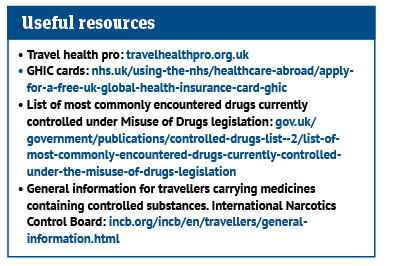
Vaccination requirements vary by country and even by location within a country. Pharmacy travel services can use patient group directions (PGDs) to provide appropriate vaccinations, ideally administered four to six weeks before travel. Precise vaccination requirements can be obtained from websites such as Travel Health Pro (see ‘Useful resources’).
Malaria prophylaxis
Although uncommon in the UK, 1,812 imported cases of malaria were reported in 2024, most of which occurred among returned travellers. While malaria chemoprophylaxis is effective, cases often result from non-adherence to the treatment regimen. Symptoms frequently appear between seven and 18 days after being bitten by an infected mosquito but can take several months to appear and rarely more than several years.
Preparations containing atovaquone and proguanil in combination are available OTC for purchase at pharmacies, although private travel services can use PGDs to supply prescription-only malaria chemoprophylaxis.
Minimise insect bite risk
In addition to malaria, mosquitoes can transmit dengue, yellow fever, chikungunya and the Zika virus. Minimising the risk of insect bites with repellents will help reduce the transmission of these dangerous diseases.
The most effective repellents contain N, N-diethyl-m-tolumide (DEET), available in concentrations ranging from 20-50%, with higher concentrations providing longer protection. DEET products can be used from two months of age and are suitable for pregnant women provided they are applied according to product instructions. Using lower concentrations is generally recommended for children.
Alternative repellents include picaridin and lemon eucalyptus extract, which contains PDM (p-menthane-3,8-diol). In addition, commercial sprays containing permethrin can be used to provide long-lasting insect repellence on clothing.
Venous thromboembolism
Prolonged immobility, dehydration and cabin pressure changes during a flight can contribute to venous stasis and hypercoagulability, increasing the risk of venous thromboembolism (VTE). The risk of VTE increases by 26% for every two hours of air travel and this relationship becomes significant after about four hours.
The absolute risk of VTE is low in the general population, but for travellers it will depend on flight duration and the presence of specific risk factors e.g. thrombophilia, pregnancy and women taking oral contraceptives. Graduated compression stockings or flight socks have often been recommended as a preventive strategy and there does seem to be a prophylactic effect if the compression is between 15-30mmHg.
Other simple measures include performing leg exercises, walking, avoiding alcohol and staying hydrated – all of which can help reduce the risk
of VTE.
Melatonin for jet lag
Normal circadian rhythm can easily adjust to time changes of up to two hours, but rapid travel across more than three time zones disrupts it. This gives rise to a range of symptoms that typically include poor sleep, delayed sleep, early wakening, and reduced mental and physical performance – collectively referred to as jet lag.
Flying eastward is often more disturbing than flying west. Although self-limiting, patients with moderate to severe symptoms may benefit from taking melatonin, which is licensed for short-term treatment of jet lag in adults and can be accessed from pharmacy travel services via a PGD.
Sun safety
Ultraviolet (UV) B radiation causes sunburn, which can be both painful and, in more serious cases, lead to heat stroke – especially when holidaying in countries with a high UV index, a measure of sunlight intensity. For example, during the summer months, the UV index in the Mediterranean region frequently reaches 8 to 10 (i.e. ‘very high’) and can peak around 9 or higher, making sun protection essential.
In the first instance, avoiding sun exposure during the hottest part of the day (11am to 3pm) is recommended. For other times, a broad-spectrum sunscreen should be used, which offers protection against both UVA (which causes skin ageing) and UVB, applied at least 30 minutes before going out in the sun.
A sunscreen with a minimum sun protection factor of 30 is generally recommended and should be reapplied every two hours, particularly if swimming or engaging in activities that might reduce the sunscreen’s effectiveness (e.g. sweating or playing sports). Typically, for a full-body application, around 40ml (6-8 teaspoons) of sunscreen is needed for adequate protection. It is also necessary to protect the lips with a sunblock.
Clothes also protective
Clothing can also be protective against the sun. The Ultraviolet Protection Factor (UPF) is a measure of how much UV radiation a fabric allows to reach the skin. The higher the UPF, the greater the degree of protection, although the UPF of clothing depends on colour and fabric type – darker and brighter colours are better at absorbing UV radiation.
Similarly, densely woven cloth, such as denim, canvas, wool or synthetic fibres, is more protective than thin or loosely woven cloth.
A sense of a fabric’s sun protective value can be gauged by holding it up to the light. If it can be seen through, it is likely to be less protective. Wide-brimmed hats also protect against the sun.
Eyes on the prize
Exposure to sunlight can cause photokeratitis, a painful eye condition that is essentially ‘sunburn’ of the eyes. An extreme form of photokeratitis is snow blindness, which can occur during a skiing holiday due to the intense reflection of sunlight from snow and ice.
The risk of photokeratitis can be significantly reduced by using sunglasses that block UVA and UVB. Sunglasses should be CE marked, indicating compliance with EU safety and environmental requirements.
Using sunscreens with insect repellents
Research suggests that the effectiveness of sunscreens is reduced by about a third when individuals use a DEET-containing insect repellent. Any DEET product should therefore be applied after sunscreen.
Traveller’s diarrhoea
Traveller’s diarrhoea (TD) is a common problem among those visiting destinations that have poor water, sanitation and hygiene infrastructure. It is most commonly caused by consuming contaminated food or water, and is often characterised by the sudden onset of abnormally loose or liquid, frequent stools. High-risk destinations for TD include South and Southeast Asia, Central and South America, and East, West, and North Africa.
In healthy patients, TD generally resolves within three to five days with adequate fluid replacement. Antibiotic therapy is generally reserved for moderate-to-severe infections. Rifaximin is licensed for TD, provided there is no associated fever or bloody diarrhoea, and can be provided via a PGD if offering private travel services.
Travel sickness
Motion sickness tends to occur when travelling in cars, boats and planes, leading to nausea and vomiting, which is provoked by either physical or visual motion. Drug treatments include antihistamines and antimuscarinic agents such as hyoscine, with the latter viewed as the standard treatment. It can be used transdermally as a prophylactic option. Nevertheless, all pharmacological agents are only partially effective at preventing motion sickness.
Bites and stings
Insect bites and stings are particularly common when travelling or visiting warmer climates. Most bites and stings are harmless, causing only temporary itching, swelling, redness and irritation. However, a bite or sting can lead to more serious allergic reactions or even an infection.
Treatments include topical or oral antihistamines, corticosteroids, crotamiton or soothing agents such as aloe vera or chamomile, which act as a natural antiseptic and have anti-inflammatory properties. Alternatively, applying a cold compress (or ice wrapped in cloth) will help alleviate any swelling and discomfort.
Sun, sea and…
When on holiday, some individuals participate in riskier sexual behaviour, combined with increased alcohol intake. This combination can pose a risk that has the potential to result in unplanned pregnancy or sexually transmitted infections. Around 50% of men and 75% of women with chlamydia are asymptomatic, for instance.
Condoms remain the most effective way of protecting against STIs. Within the UK and the European Union, people should look for products that carry CE and British kitemarks, which certify they are suitable for penetrative sex. Unfortunately, certification standards may differ across countries, risking the entry of substandard or even counterfeit condoms onto the market.
First aid essentials
Finally, to avoid that “I wish I’d packed that” feeling while on holiday, pharmacists should advise customers to have a checklist of essential items before departing including the components of a basic first aid kit. Basic items will include antiseptic wipes, sterile dressings, oral rehydration sachets, painkillers, tweezers and a hand sanitiser.
Other essentials depend on the holiday location e.g. bite/sting creams, insect repellents and soothing creams/gels for sun exposure for holidays in warmer climates. Conversely, lip balm and moisturisers are handy if a customer is heading off somewhere cold.
In the departure lounge
Remember that customers just want to relax on holiday, temporarily leaving all their worries behind. Community pharmacists offering private travel health services – and knowledgeable pharmacy support staff – can support and advise holidaymakers, and help them to stay healthy while away from home.

Share:


In Practice
We know you want to continue to build on your practice, why not hear from others in the sector striving to do the same.