





 1 Min
1 Min In Practice

Follow this topic

Bookmark

Record learning outcomes
“I see the place where I practise as the consulting room — not the dispensary,” says Alasdair McIntyre, looking around the immaculately-ordered, well-equipped clinical space where we are sitting. It is a striking comment and one that epitomises how rapidly community pharmacy practice is changing in Scotland.
Alasdair is the owner of Burnside Pharmacy in Rutherglen, situated three miles south-east of Glasgow. We are talking in what used to be a bank vault. Having run his business in this friendly small town since 2003, Alasdair bought the former Royal Bank of Scotland branch directly opposite his original pharmacy a few years ago and moved across the road.
The new premises, at least double the size of the old pharmacy, allowed him to incorporate a dispensing robot and two consulting rooms, and provide a better, more modern experience for his patients. Crucially, given the pace of change seen in community pharmacy in Scotland, it enabled him to expand the range of clinical services he could offer with prescribing playing a central role.
Pharmacists in Scotland have been able to prescribe independently for common clinical conditions since September 2020 through the NHS Pharmacy First Plus service.
However, Alasdair was an early adopter of pharmacist prescribing back in the mid-2000s, when he practised as a supplementary prescriber in local GP surgeries. Operating under clinical management plans agreed with an independent prescriber, typically a doctor, the role consisted mainly of polypharmacy reviews for pain and depression. Much has changed since then.
With independent prescribing set to expand in a big way among community pharmacists in England in the next few years, I wanted to get a sense of what this looked like in practice at the pharmacy coalface. So, accompanied by Numark chair Harry McQuillan, the former chief executive of Community Pharmacy Scotland, I headed to Glasgow to find out.
High demand
One of several Pharmacy First Plus providers in the area, Alasdair is busy and his appointments diary full. The fact he operates a booking system at all, which some might say runs counter to community pharmacy’s open access model, is testament to the high level of demand he faces.
“Appointments were something I personally wasn’t happy with but understood they were necessary for the safety of my patients and my practice. At the height of the recent winter viral outbreak, we were doing as many as 30 Pharmacy First Plus consultations a day for things like chest and ear infections, on top of our regular Pharmacy First work. You need to dedicate time for this – not just for the consultation but all the administration too.
“We encourage GP practices and patients to contact us first, rather than just turn up. We’ll then determine if we can see them right away, or whether we’ll need a little more time and arrange an appointment. Most patients are fine with that – it’s what they are used to with their GP surgery.”
Alasdair’s hope is that as more pharmacies come on board with Pharmacy First Plus, he won’t need to have appointments while still allowing for a manageable workload. “If every pharmacy had a pharmacist prescriber, so many common clinical conditions could be seen away from GP practices, saving a colossal volume of appointments. At the moment, with a limited number of pharmacist prescribers, it puts a certain amount of pressure on us. Ultimately, however, I think the service will work really well.”
Not that it is without its challenges. The supporting IT is clunky and the administrative burden onerous. “It’s the one complaint I have – I spend so much time on admin,” says Alasdair.
“I could see so many more patients if the service infrastructure was slick and quick, but it’s slow and time consuming. We send information to the GP practice, but what each surgery does with it varies. Mostly, it has to be scanned and added to the patient record – that’s a big failing. The IT integration is poor.”
Alasdair is an experienced prescriber but nonetheless is keen to continue to develop his skills and competences, “particularly in areas outside my comfort zone”. He does this by seeking training and guidance from other healthcare professionals where he can. He encourages pharmacists to start prescribing as soon as they can after qualification and gain as much practical experience as possible.
Training programmes like Teach and Treat, where experienced and well-established pharmacist prescribers can offer support to trainees, are also helpful in building confidence and competence.
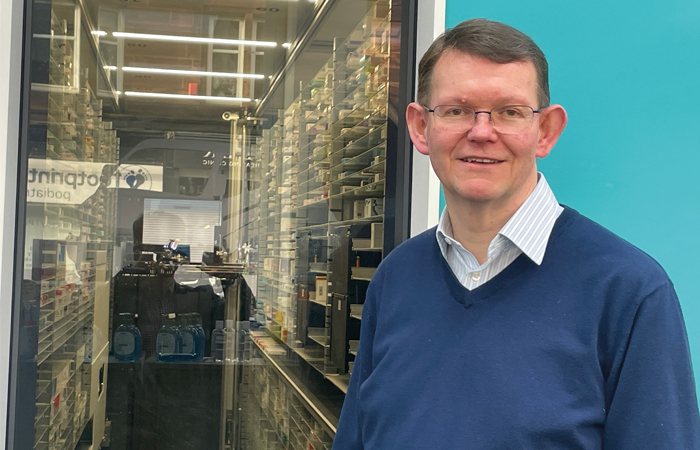
Alasdair McIntyre, Burnside Pharmacy
Building confidence
“Pharmacy First Plus is an important first step because you need to give people confidence in what they’re doing,” says Alasdair. “Common clinical conditions is the way to go because you need a body of prescribers who are prescribing in the area where they work. We don’t have the capacity to take pharmacists away from their pharmacies to practise somewhere else. We need to deliver prescribing services where patients are and where we are.”
What about scope of practice? Alasdair emphasises the importance of prescribing within one’s competence and the need for continuous learning but says pharmacists should not wait until they are experts in every aspect of a condition before starting to prescribe. That said, he does get confronted with situations where he thinks, ‘should I prescribe for that?’.
He describes a patient who came to see him on a Saturday with an apparent flare-up of gout but hadn’t had time to go to his GP for a formal diagnosis. “I was fairly convinced it was gout but I wasn’t confident to diagnose, nor totally sure what the treatment should be for an acute exacerbation. What worried me was – what don’t I know? So I gave the patient some anti-inflammatories to keep him going until Monday when he could see his GP. I subsequently chatted to his GP and arranged some training. A few months later, the patient comes in with another exacerbation, and I was able to prescribe something for him.”
Alasdair sees prescribing as an integral part of his practice and a necessary investment in patient care with huge potential to significantly reduce GP workload and improve access to the system.
“The service has been well received, with patients often referred to us by GPs when their appointments are full. The challenge now is to persuade the Government to invest in the service – that’s the rate limiting step. GPs are busier than ever. Pharmacies are well placed to take on more and prescribing is key to that. It would be a travesty if the service wasn’t extended.”
Technology driven
The use of robotics continues to transform pharmacy operations. Introducing more automation in the dispensing process doesn’t just enhance accuracy and safety, it creates the headroom necessary to provide more clinical services and secure additional NHS funding.
That’s the approach taken by Mark Feeney, owner of Bannerman’s Pharmacy, a group of five pharmacies situated across the central belt of Scotland in Glasgow, Kirkintilloch and Dunblane. Mark was fine-tuning the operation of his new Meditech dispensing robot when I caught up with him in his Possilpark branch, the ‘hub’ of what will be a busy hub-and-spoke arrangement for the business.
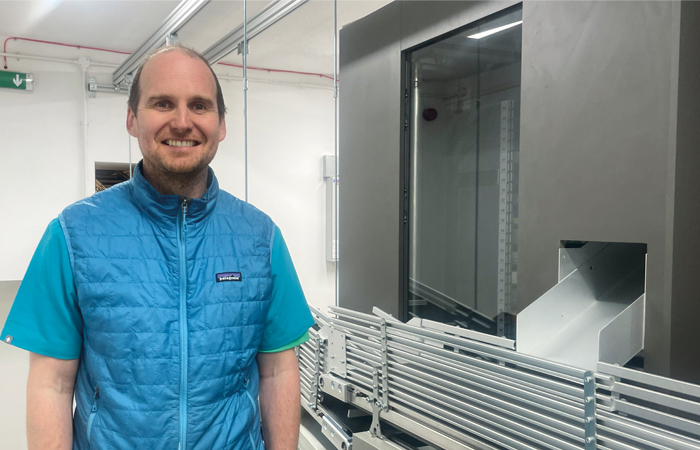
Mark Feeney, Bannerman's Pharmacy
As at Burnside Pharmacy, nearly all his pharmacists are prescribers, providing a wide range of services including Pharmacy First, opiate replacement therapy and the weight management injections Mounjaro and Wegovy – “a real growth area in the last six months”, says Mark.
A member of Community Pharmacy Scotland’s board and a former pre-reg pharmacist at Bannerman’s, Mark completed his independent prescriber training in 2020 and, despite a hectic schedule, still manages to spend most of his working week in patient facing roles. So what does prescribing look like at his small group of pharmacies?
“Most of it is done through the Pharmacy First Plus scheme, which we currently operate in four of our five sites,” says Mark. “We run it as a walk-in service, although we are looking at putting in place an appointment system, simply because demand is increasing so quickly as more patients are signposted from general practice. We occasionally prescribe out of hours providing unscheduled care and for our travel vaccinations service, which is picking up again after Covid.”
Growing footfall
Increasing patient demand for face-to-face interactions drove Mark to look at how he could standardise or automate the technical aspects of the job so that his pharmacists have more time to see patients.
“The pinch-point now is the door opening and people coming in for advice. Prescription items are going up gradually, but footfall and demand for our pharmacists’ time has gone up exponentially in recent years,” he says. “I try to make sure that we have the infrastructure, technology, hardware and software in place to meet that patient demand.”
Pharmacy is almost a victim of its own success, Mark believes. “I’d like to see the Scottish Government recognise the increased workload and growing numbers of consultations, and hopefully this will be reflected in future contract settlements.”
Prescribing is central to the care offer at Bannerman’s and the career development pathways of its pharmacists, all of whom are wearing medical scrubs. “For our pharmacists to reach the highest level in the business, they have to be prescribers. That’s a key requirement of the role. I want people to recognise that we are one of the more clinical pharmacy operators. It’s an important differentiator for us and an essential part of our company ethos.
“Nothing upsets me more in pharmacy than a patient getting passed from pillar to post and no one taking ownership of their care,” he continues. “I don’t like to see patients having to go to different pharmacies for different services. Prescribing is a really important tool that gives us the ability to fix someone’s problem. And if you can do that, then hopefully you gain their loyalty. It’s simply good patient care and good business sense too.”
While the IT infrastructure underpinning prescribing is “seriously creaky and urgently needs fixing” – a common theme on my Glasgow visit – Mark can see community pharmacy taking over the management of long-term conditions in the near future. “Pharmacy practice is changing. It is moving towards building a package of care around the patient that includes services as well as medicines supply. That is community pharmacy’s sweet spot.”
Get with the times
It may be an unfashionable thing to say but prescribing might not be for everyone. Data from last year’s salary survey by The Pharmaceutical Journal found that not all existing registrants actually want to become an independent prescriber. Family commitments making it difficult to find the necessary study time or older pharmacists feeling they are too close to retirement to retrain were two of the reasons given.
Other barriers to community pharmacists becoming active independent prescribers included minimal protected learning time, difficulty securing supervision and, for those who have managed to gain a prescribing qualification, the lack of opportunity to use it – none of which, incidentally, appear to have held back the roll-out of pharmacist prescribing in Scotland.
Emma Boyle, Kennyhill Pharmacy
“The training is challenging, even a little nerve-wracking,” admits Emma Boyle, a pharmacist prescriber at Kennyhill Pharmacy on the Cumbernauld Road, opposite Haghill Park Primary School, part of the 33-strong independently-owned M&D Green group.
“Your practice as a pharmacist is being tested, so I completely understand that it might be difficult for longer qualified pharmacists. However, the role of pharmacy is changing and we have to get with the times. For me there was no question about it. I had to get on board [with prescribing].”
The risk for existing registrants who opt not to go down the prescribing route is that they may not have the skills that employers are looking for in the future, she says. “If you want to be at the forefront of community pharmacy, prescribing is definitely something you should do.”
So what next for Emma, who was in one of the first cohorts of community pharmacists in Scotland to undertake the Practice Certificate in independent prescribing in 2022? M&D Green has already taken part in an out-of-hours care pilot and is looking at sexual health interventions as well. Both provide prescribing opportunities.
The company is also doing a great deal to support its pharmacist prescribers with six-weekly training sessions and experts coming to talk about certain subjects.
“Pharmacy First Plus is definitely where we have the most impact day-to-day at the moment but I want to develop my competencies in different areas. We will continue to look at local needs where existing services are overloaded,” she says. “Prescribing can enable us as a business to do so much more for patients.”
Aim is universal coverage
The managing director of the M&D Green group is founder, Martin Green, who has been chair of Community Pharmacy Scotland since 2006 – so who better to ask about the future of pharmacist independent prescribing in Scotland when he popped into Kennyhill Pharmacy.
“The increase in pharmacist prescriber numbers across the network is going well,” he told me. “Training places continue to be oversubscribed each year, but there are significant numbers of pharmacists going through the programme. We’re probably close to around 30 per cent of the network having access to an IP. That figure will probably be not far off 50 per cent within the next 18 months.
“There is the added element of the pharmacist graduates coming out in 2026 able to prescribe, but none of us are sure exactly what they’re going to do from day one and where they will fit in the bigger picture,” he points out.
So is the ambition universal coverage – in other words, every community pharmacy in Scotland with a pharmacist prescriber? “I don’t see why not,” says Martin. “We are certainly on that trajectory. If you’d asked me about this 10 years ago, I’d have said it was an aspiration, but it’s now within touching distance. In the next five years there will be a prescriber in every pharmacy in Scotland – and, in many pharmacies, more than one.” How successful this will be in supporting the NHS depends to a large extent on further refining the service and having the right funding in place, says Martin.
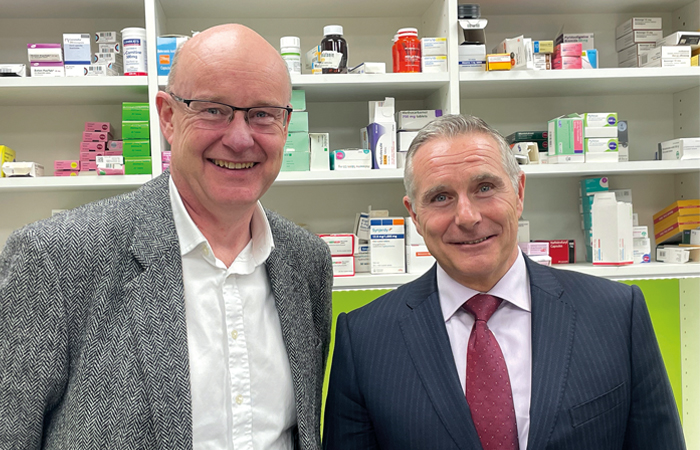
Harry McQuillan, Numark chair (left) and Martin Green, M&D Green pharmacy group
“The system for prescribing, as originally set up, wasn’t hugely sophisticated. It had a purpose, which was to encourage pharmacists to become prescribers and remunerate them in a different way from how they were remunerated in the past, which was on a sessional basis through the health boards. If I’m being honest, with my commercial hat on, it simply doesn’t work. It was meant for those pharmacists who had a passion for prescribing to becoming prescribers. It wasn’t because it added any revenue commercially to the pharmacy,” he says.
“We took a view that if we could add value to community pharmacy businesses by having an independent prescriber there, then that would accelerate the [prescribing] roll-out – and it did. We now have to refine the system to change behaviours, and encourage pharmacists to engage with more patients and spend more time away from the dispensary and in the consultation room. I believe it is in our gift to do that.”
What Pharmacy First Plus has done in particular is enable community pharmacists to treat acute, typically self-limiting conditions and move the focus away from long-term conditions, which is where pharmacist prescribers have typically operated in the past, says Martin. “This approach has been successful because, in terms of adding value to the wider NHS, it relieves a lot of pressure elsewhere in the system such as general practice and out-of-hours services.”
However, he sees several other potential avenues where pharmacist independent prescribers could be used to manage long-term conditions in the community. “We’ve never quite managed to progress our Medicines Care and Review service, which puts patients onto serial prescriptions for their long-term conditions. Being an independent prescriber gives you an opportunity to better manage those conditions.
“I can see, within the next few years, less need to compartmentalise these services under Pharmacy First, Medicines Care and Review, for example, and bring them together under one broad heading, which is caring for the patient. So what we’re delivering in two or three years’ time might look quite different from today. A prescriber could be dealing with a whole host of different issues when seeing a patient.”
What about potential challenges? Martin is clear that the supporting infrastructure needs to improve – contractors are soon to start collecting data on the impact of IP services and prescribing activity to demonstrate the value to the Scottish Government – and the funding model re-examined. “It needs to evolve to recognise things like pharmacies operating with multiple IPs and opening for extended hours.”
The IT should enable direct communication with GPs and auditable consultations, he adds.
“The Scottish Government is very supportive of the service, which has been helpful, but actually hasn’t found any dedicated money to back prescribing, which is currently supported by repurposed money from within our contractual framework. If we are to get the service to where it needs to be, it will need some new investment.”
Central to practice
The overriding impression I took away from my day talking to community pharmacist prescribers in Glasgow was how central – even routine – prescribing has become in their practice, driven largely by the Pharmacy First Plus service.
It was also very apparent how rewarding the pharmacists, all at different stages of their careers, found using their prescribing skills and knowledge to benefit their patients.
Having the right policy framework in place, carefully developed over a sustained period, is obviously helpful. As in Wales, health planners in Scotland identified gaps in primary care provision that could be plugged effectively by pharmacist independent prescribers – and the sector has risen to the challenge. Contrast that to England, where it seems a case of: ‘let’s make everyone a prescriber.... now what shall we do with them?’.
The learnings from the Pathfinder programme notwithstanding, it is far from clear how pharmacist prescribing will work in England.
As highlighted by the recent paper from Warner et al, there are complexities to resolve around the separation of dispensing and prescribing (and balancing commercial and clinical pressures), supervision and ongoing support for prescribers, funding, regulatory oversight, liability and scope of practice – to give just a few examples.
Yet Scotland shows what’s possible. Harry McQuillan sums it up succinctly: “For community pharmacists, the future must be about the safety of medicines supply, including prescribing, and ensuring patients get maximum benefit from their therapies. We must challenge ourselves to move towards a more clinical future by shifting the focus towards providing care through services.
“Independent prescribing is set to become a cornerstone of community pharmacy. With the right support, pharmacists can play a greater role in managing chronic illness, treating common conditions and making public health interventions through prescribing”.
Pharmacists in Scotland are leading the way in what amounts to a transformation of community pharmacy’s practice model. It was great to see.
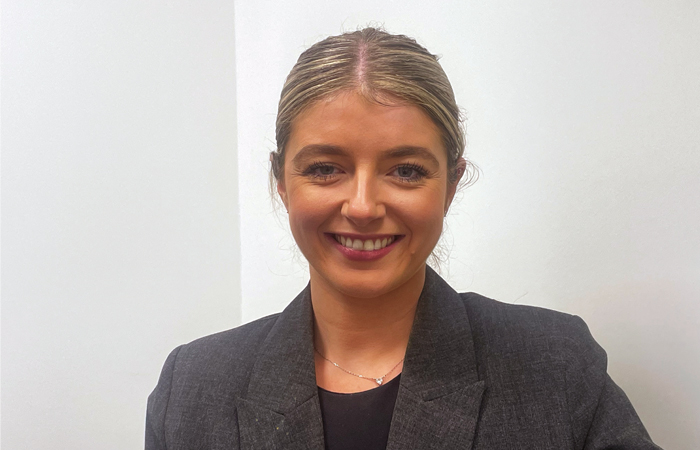
Michaela McEleney, pharmacist prescriber, Kennyhill Pharmacy
“I’ve been qualified as an independent prescriber for just under a year, so I’m still relatively new to it, but it’s great – I really enjoy it.
I prescribe for patients with common clinical conditions about three days a week when there is another pharmacist working with me in the pharmacy. This gives me the time to do the consultation and the second pharmacist clinically checks what I’m prescribing. Having two pharmacists definitely takes the pressure off the operation of the pharmacy when I’m in the consultation room.
After I received my prescribing qualification, I got in touch with two of the local GP surgeries and sent them a list of my competencies and the conditions for which I intended to prescribe. Handling common clinical conditions makes so much sense for community pharmacy. The doctors were really keen on the idea. I ask them to get patients to phone ahead, just to make sure I’m here and I’ve got the time to do it.
Each consultation takes a minimum 20 minutes, which gives me time to speak to the patient, record my notes and complete the paperwork. Most of the patients are grateful for the appointment and the opportunity to get our advice and support. When some of them come in for the first time, and I’m checking their oxygen levels or using a stethoscope to listen to their chest, they say things like ‘I didn’t realise that a pharmacist could do this!’. When I explain to them that this is what pharmacists do these days, they appreciate how thorough we are and the time we can give them, especially if they’ve been unable to get a GP appointment.
Sometimes it’s hard to manage patient expectations – for instance, if they are expecting antibiotics for a sore throat. However, pharmacist prescribing makes so much sense for patients and the health service.
In a couple of years’ time, I think most community pharmacists will be based in consultation rooms providing clinical services and doing a lot more prescribing. For me, it’s been a very positive experience.”

Share:


In Practice
We know you want to continue to build on your practice, why not hear from others in the sector striving to do the same.