
The Pharmacy First service in England allows community pharmacy teams to complete episodes of care for seven common conditions. This toolkit provides an overview of the clinical pathway and PGDs used to deliver consultations for acute sore throat plus essential information on the assessment, diagnosis and management of this common condition. Compiled by Patrick Grice.
This toolkit is designed to support pharmacists to deliver the Pharmacy First service in England (and similar schemes) for sore throat. It covers:
After reading the toolkit you will be able to conduct a simple examination of the throat; know which conditions and red flags require referral; be confident in using a clinical scoring system to assess the likelihood of bacterial infection; and provide appropriate treatment and advice.
Download the Toolkit PDF here.
The CPD modules accompanying this toolkit can be accessed here:
Pharmacy First: Sore throat part 1 and Pharmacy First: Sore throat part 2
Sore throat is one of the commonest presentations in primary care and community pharmacy teams have been advising effectively on the condition for many years. Drawing on the NICE Sore throat (acute): antimicrobial prescribing guideline [NG84] and CKS Sore Throat, this toolkit will support your decision-making regarding the provision of self-care advice, OTC medicines, the small number of occasions when a sore throat might benefit from antibiotics, and when referral is needed.
Around 90 per cent of sore throats that present in the pharmacy will be caused by viral infection. Clinically, it is difficult to differentiate viral and bacterial infections and the majority of both are self-limiting.
As such, it may be easy to ascribe all sore throats to viral causes. It is important, therefore, to keep an open mind for each patient who presents with a sore throat or upper respiratory tract symptoms. A good history and a comprehensive examination should allow for a confident diagnosis.
Download a PDF of the acute sore throat clinical pathway here or see below:
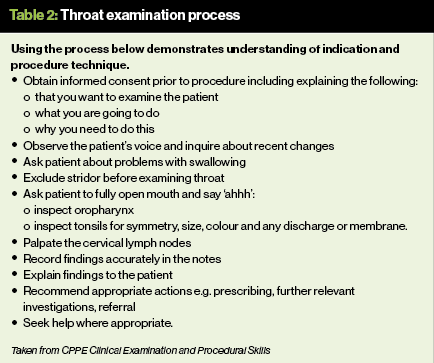
Use the clinical pathway for sore throat to help guide your diagnosis. Be alert for anyone with systemic illness or signs of sepsis, breathing difficulties or stridor, suspected epiglottitis or diphtheria, those who appear to be dehydrated, or where a pharyngeal abscess is suspected. Refer such patients urgently to A&E for further assessment or call 999.
In the UK, sore throats are one of the main reasons for prescribing antibiotics but even where there is bacterial infection, antibiotics make little difference to outcome, and are unnecessary in most cases. Check for possible differential diagnoses such as scarlet fever, quinsy, glandular fever or suspected cancer. An urgent GP referral may be necessary.
Patients who are immunosuppressed or taking medicines known to cause agranulocytosis (e.g. methotrexate, sulfasalazine, carbimazole, propylthiouracil, cotrimoxazole, valganciclovir, clozapine, carbamazepine, all chemotherapy) should also be referred to their GP.
Information gathering for sore throat will include three elements:
• The pharmacist’s usual questioning
• Palpation of the neck
• Examining the appearance of the throat.
These last two actions enable the use of a clinical scoring system to assess the likelihood of bacterial infection. The use of clinical scoring systems is recommended by NICE. Pharmacy First PGDs refer to FeverPAIN. Higher scores suggest more severe symptoms and a likely bacterial (streptococcal) cause. NICE makes recommendations on when antibiotics might be of benefit.
Sore throats are often associated with other symptoms of a cold, and determining whether cold symptoms, particularly a cough, are present is a useful way to triage cases.
A cold makes a throat infection less likely as a viral cause is more probable.
Use the FeverPAIN scoring system to determine next steps:
• Score 0 or 1: offer self-care advice and pain relief
• Score 2 or 3: offer self-care advice and pain relief
• Score 4 or 5: Gateway Point
If the Gateway Point in the clinical pathway is reached:
A useful way to think about the consultation is to cover the 3 E’s – Empathise, Evaluate and Educate, summarised below.
Tweaking sentences or adding short statements to your explanations can present information in a way that is most helpful for patients.
The CHESTSSS consultation structure, developed by the Royal College of General Practitioners as part of the TARGET toolkit and based on the evidence for effective communication strategies, is a quick way to help remind you what to tweak in your discussions with patients about antibiotics in particular.
CHESTSSS can help you to remember specific phrases which:
• Reassure patients
• Increase patient understanding and satisfaction with a prescribing decision
• Avoid re-consultations
• May be particularly helpful for patients who are expecting antibiotics.
Table 1 shows how CHESTSSS could be tailored to a consultation about sore throat.
In making a diagnosis be aware of the common (non-streptococcal) infectious causes of acute sore throat, and their signs and symptoms. These are set out in the NICE CKS on acute sore throat. They include:
Age: Streptococcal (bacterial) throat infections are more likely in children of school age.
Duration: Most sore throats will get better within seven days. If present for longer and not resolving, then the patient should be referred to the GP surgery for further advice.
Associated symptoms:
Previous history: Recurrent bouts of throat infection, such as several episodes of ‘tonsillitis’ in the past year, would mean that referral is indicated.
Smoking habit: Smoking will exacerbate a sore throat. If the patient smokes, then it can be a good time to offer advice and information about quitting.
Present medication:
Taken from CPPE's Clinical Examination and Procedural Skills
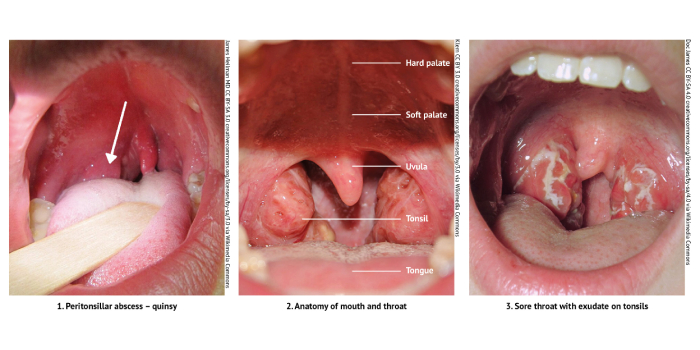
With a sore throat, the tonsils may swell and become red, and pus may appear on them as white spots. Symptoms typically get worse over two to three days and then gradually go, usually within a week. Often described as tonsillitis, this does not normally require treatment.
The presence of tonsillar exudate (pus on the tonsils – see below) may increase the likelihood of a bacterial infection and is one of the items that scores in FeverPAIN. However, exudate is sometimes seen with viral infections and sometimes the throat can appear almost normal without exudates in a streptococcal (bacterial) infection.
Tonsils often have white patches on them in healthy people. These are part of the lymphatic immune system and are sometimes called tonsillar crypts.
An important point is some people may not have tonsils. They may not volunteer this information so their absence on examination may be a surprise. Tonsillectomy has been a relatively common procedure until recent years. It is still possible to have a sore throat and potentially a bacterial infection after a tonsillectomy.
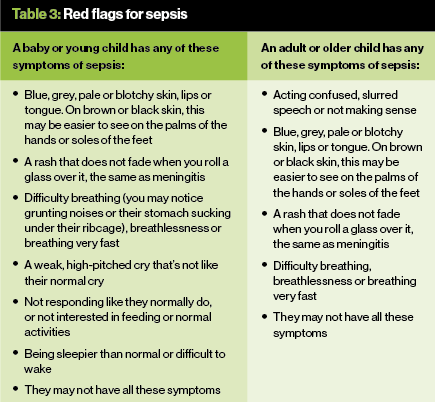
Most of the people who attend the pharmacy with a sore throat will be unwell and have pain but are not severely ill. A few patients may attend who have symptoms suggesting more severe illness or who are at risk of severe illness.
The most important requirement is to recognise severely ill patients and ensure they get urgent care. Also, some patients may seek assessment by the pharmacist but do not meet the necessary service criteria. These patients will need referral to their GP practice (or to urgent care, if required).
The NHS Health A-Z lists the following symptoms as red flags for sore throat. Patients (including children) should call 999 or go straight to A&E, if they are:
The other diagnosis to consider is sepsis – see Table 3.
Patients who appear dehydrated may also need urgent referral. If quinsy or another throat/neck abscess is suspected, these should be referred to A&E urgently.
Same day
• Has symptoms and signs of a more serious illness or condition
• Has a persistent high fever (>38°C)
• Has significant difficulty in swallowing (dysphagia)
• Has a high risk of complications – immunosuppressed or on treatment for cancer
• Is taking carbimazole, methotrexate or azathioprine
Less urgent referral
• Not systemically unwell but condition not covered by PGD or not meeting PGD criteria
• Masses/unilateral swellings (possible cancer)
• Persistent mouth ulcer/lesions (possible cancer)
• Recurrent problem, or treated within last month
• Has had the sore throat, and is not getting better, for longer than seven days
• Persistent, ‘low grade’ sore throat for over three weeks; may be unilateral (possible cancer)
• Has had recurrent bouts of throat infection/tonsillitis
• Has hoarseness that has lasted longer than three weeks.

Most sore throats are self-limiting and 90 per cent of patients feel better or improve within one week of the onset of symptoms, whatever the cause and with or without antibiotics. NICE states that “antibiotics make little difference to how long symptoms last or the number of people whose symptoms improve”.
Pharmacists can offer symptomatic treatment to provide some relief from discomfort and pain until the infection subsides. Oral analgesics are the first-line option and recommended for all patients, even those given antibiotics.
A systematic review of clinical trials found that simple analgesics (paracetamol and ibuprofen) are very effective at reducing the pain from sore throat. Some medicated lozenges and pastilles have a soothing effect.
NICE states that “medicated lozenges containing benzocaine, hexylresorcinol or flurbiprofen may help to reduce pain in adults”. There is also some evidence that benzydamine spray is effective for sore throat pain.
Antibiotics are indicated in a small proportion of sore throats and have been shown to reduce the duration of symptoms by an average of just 16 hours.
Providing patients with appropriate with self-care advice aims to prevent dehydration where there is fever, and to manage the discomfort associated with drinking and eating:
Antibiotics are indicated in a small proportion of sore throats and have been shown to reduce the duration of symptoms by an average of 16 hours. Despite efforts to reduce usage in sore throats they are prescribed to as many as 60 per cent of patients who attend general practice with a sore throat.
The NICE guideline on antimicrobial prescribing includes a useful visual summary of its recommendations on antibiotic use in acute sore throat.
Where pharmacists are authorised to make an NHS supply of antibiotics under a PGD there is the opportunity to reduce their unnecessary use and reinforce antimicrobial stewardship. The use of clinical scoring systems and evidence-based communication techniques are key to appropriate use of antibiotics.
NICE makes specific recommendations on which antibiotic to prescribe – normally this would be phenoxymethylpenicillin (penicillin-V), or clarithromycin in those with penicillin allergy.
Service-specific PGDs define the inclusion and exclusion criteria for different antibiotics (see later). The main contraindication is allergy/hypersensitivity to an antibiotic – usually penicillin.
Acceptable sources of allergy information include the individual, their carer/parent/guardian, or their National Care Record (but bear in mind these sources are not always accurate).
Overuse of antibiotics contributes to antibiotic resistance, and antibiotics can also cause side-effects such as diarrhoea, nausea and vomiting.
Where the decision is not to give an antibiotic there is good evidence that many patients are satisfied if they are listened to carefully, are examined thoroughly, and provided with an explanation with alternatives recommended for relieving symptoms.
Studies in general practice found there is often a mismatch between what the GP thinks the patient wants and what the patient actually wants, and this may also happen with pharmacist consultations.
The Royal College of General Practitioners has developed the CHESTSSS consultation structure as part of the TARGET toolkit dealing with “Finding the right words”, based on the evidence for communication strategies that work.
Pharmacists managing sore throats may wish to talk their strategy through with local GP practices.
How the local practices manage patients with sore throats, how they use clinical scoring systems (do they use FeverPAIN or CENTOR, for example), and what interventions they advise for symptomatic relief are all important issues.
Agreeing a common approach ensures that patients are not confused by variations in practice and will enhance consistency and continuity of care. This will also mean that there is a commonality of approach if patients wish to seek a further opinion with other primary care providers.
It may be that your local integrated care board or local primary care network have an agreed plan of work for this important area of antibiotic prescribing. Liaising with the local clinical leads, particularly those for antimicrobial stewardship, will be useful.
NHS England: NHS Pharmacy First
Pharmacy First service specification
Pharmacy First clinical pathways
Acute sore throat PGDs: Supply of penicillin V tablets/oral solution/oral suspension
Supply of clarithromycin tablets/oral suspension/solution
Supply of erythromycin tablets/oral suspension/oral solution
Clinical guidance and resources
NICE CKS: Diagnosis of sore throat
NICE Guideline 84: Sore throat (acute): antimicrobial prescribing
NHS Health A-Z:
RCGP: TARGET antibiotic checklist (plus foreign language versions)
RCGP TARGET antibiotics toolkit hub (includes resources for community pharmacy settings)
Patient UK: Professional articles – Sore throat
General information
FeverPAIN score
RCP National Early Warning Score: NEWS2
Green Book ch28a: Definition of immunosuppression
Electronic Medicines Compendium
NICE: Competency framework for health professionals using PGDs
Information for patients
RCGP: TARGET Treating your infection – Respiratory tract infection leaflet
NHS Health A-Z: Sore throat
Patient UK: Sore throat