



How effective are at-home LED masks for acne?
Ross Ferguson,
23 Mar 2026 1 Min
1 Min

Ross Ferguson,
23 Mar 20261 Min
Ross Ferguson,
23 Mar 20261 Min


Some patients firmly believe that exposing themselves to the sun can improve their acne. Sunlight is part of the electromagnetic spectrum and comprises roughly 50% visible light (400 – 700 nm), 40% infrared (700 – 2,000 nm), and the remaining 10% ultraviolet (100 – 400 nm). Initially, it was thought that the UV portion of the solar spectrum might be responsible for the benefits in acne.
In 1978, researchers found that irradiating the skin with UV radiation in patients with mild to moderate acne for 8 weeks led to improvements in acne in about a third of patients. Whether other wavelengths within the solar spectrum might improve acne was unclear, but a chance observation nearly 100 years ago helped pave the way for the development of light therapy in acne.
In 1927, it was found that facial comedones displayed an orange-red fluorescence when examined under a Wood’s UV lamp. Nevertheless, it took another 40 years before it became recognised that this effect was due to the presence of a porphyrin, coproporphyrin III, produced by Corynebacterium acnes (C. acnes) resident within the skin.
The peak absorption of light for coproporphyrin III was found to be 415 nm (i.e. blue light), and at this wavelength, the porphyrin generates reactive oxygen species, which have a bactericidal effect on C. acnes.
Increasing the wavelength further to 630 nm (red light), is less effective at stimulating coproporphyrin III, but it penetrates deeper into the skin and downregulates sebum production.
Based on these observations, in 2000, researchers conducted the first randomised trial using a combination of blue and red light in 107 patients with mild to moderate acne. The results showed that the combination was more effective than blue light alone for both comedones and inflammatory lesions.
Moreover, a 2007 study confirmed that red light alone was also effective for acne. A 2021 systematic review and meta-analysis concluded that blue light therapy was effective for acne but had a greater effect on inflamed than non-inflamed lesions. When compared, blue and red light appear similarly effective for mild to moderate acne.
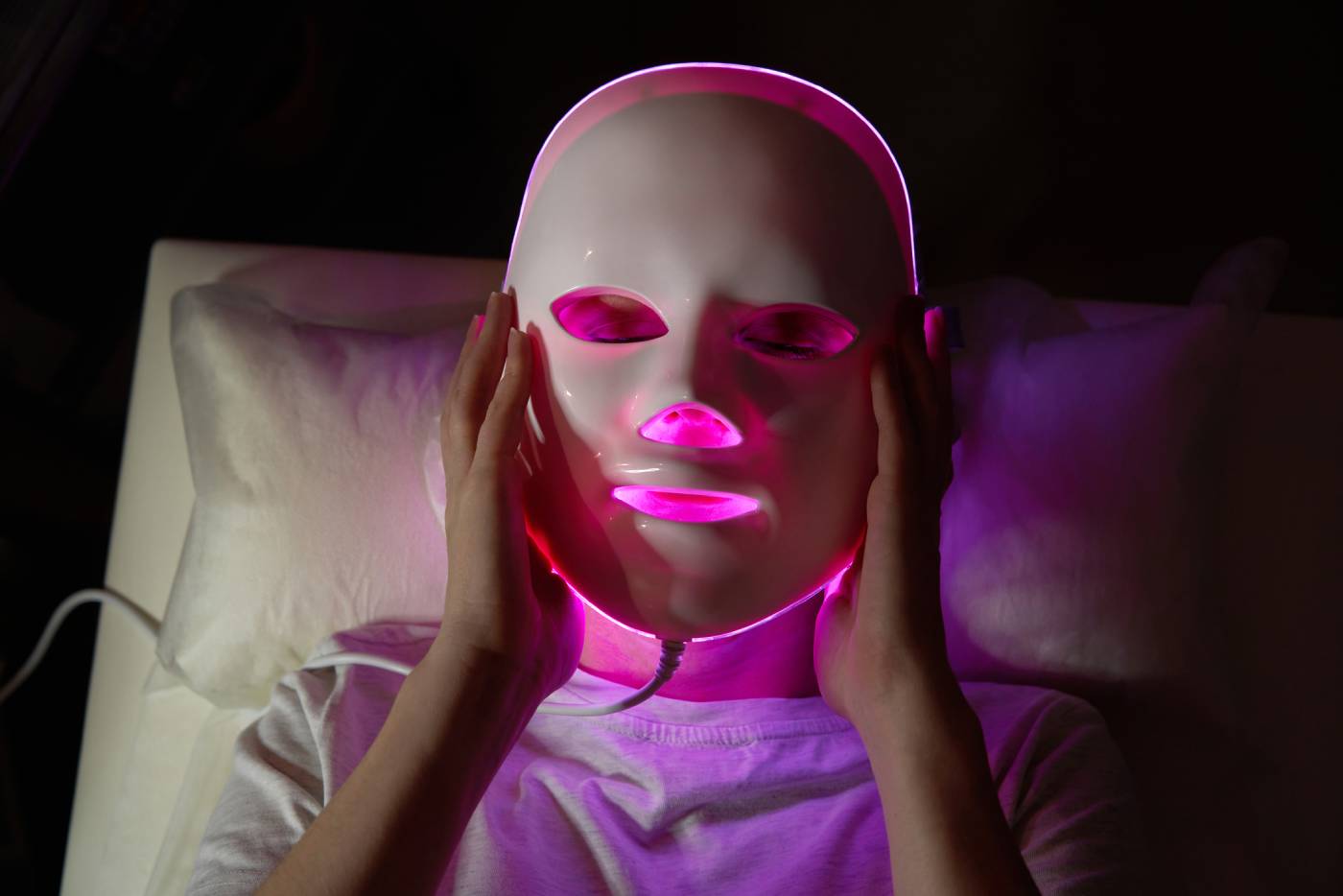
An at-home LED device or LED face mask emits light at specific wavelengths onto the skin for acne treatment. These devices are certainly big business with a global market valued at 266.44 million US dollars in 2023. But do they actually work?
This was the subject of a recent systematic review and meta-analysis. The authors included only randomised trials that assessed the efficacy of the devices based on changes in lesion count or improvements in Investigator Global Assessment (IGA) scores. Overall, only six trials, with 216 participants who had mild to moderate acne, met the inclusion criteria and used either blue (414-445 nm) or red (630–670 nm) light, or a combination of the two.
Compared with controls, on average, there was a 45.3% reduction in inflammatory lesions and a 47.7% decrease in non-inflammatory lesions, both of which were statistically significant (p < 0.001). The researchers concluded that both blue and red light were effective, but the greatest effect was achieved by combining the two. In addition, there were no safety concerns.
Moreover, some encouraging data suggest that light therapy is superior to topical treatments such as benzoyl peroxide. However, a recent survey of devices available in the US market highlighted some concerns.
A total of 25 devices were examined, and the researchers found that none had supporting data from randomised trials for either efficacy or safety. This does not mean that blue and red light are ineffective; it simply means that the specific device has not been tested. In the UK, LED at-home face masks require a certification mark indicating that the product has been developed and tested in accordance with the relevant regulations.
However, while these at-home masks are registered with the MHRA, they are not medically endorsed by the regulator. In fact, when an LED at-home face mask is specifically marketed to treat acne, the manufacturer must provide evidence that the device works as intended. Unfortunately, in practice, this is rarely the case. An additional concern is the cost of these masks, which varies considerably.
So, while at-home LED masks are effective for mild to moderate acne, pharmacy teams face the challenge of identifying and recommending a specific product for their patients.


