


 Capacity to consent
Capacity to consent
With sufficient mental capacity, an individual can make their own decisions. The legal context for capacity is governed by the Mental Capacity Act (MCA) 2005 and applies to young people aged 16 to 17 and to older adults. The Act presupposes that an individual has the necessary capacity to consent, including those with a disability or impairment, unless otherwise demonstrated.
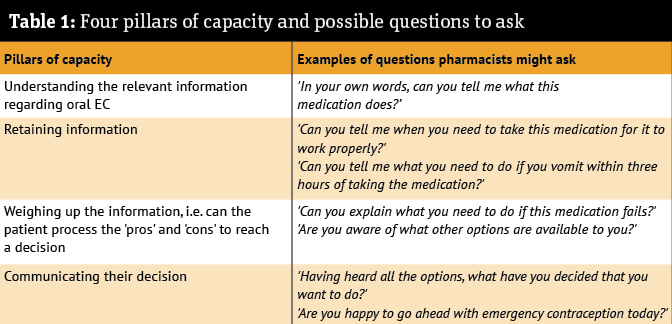
The four key pillars of capacity are shown in Table 1 (below), along with examples of questions a pharmacist might ask as part of an assessment. Nevertheless, it is essential to recognise that capacity is context- and decision-specific. In other words, someone might have the capacity to decide where they want to live, or what they would like to eat, but lack the capacity to make decisions over their medication.
The Mental Capacity Act stresses that patients should be supported to make their own decisions wherever possible, and helped to understand information, communicate choices, and, if required, be given more time to process decisions. Furthermore, while a pharmacist might disagree with a patient's decision, they must respect it if the patient has capacity.
Where a pharmacist believes a patient lacks capacity, GPhC guidance advises seeking input from other healthcare professionals or those involved in the patient's care. Under the Mental Capacity Act (MCA) 2005, any decisions for individuals without capacity must be made in their best interests.
In Scotland, this responsibility falls under the Adults with Incapacity (Scotland) Act 2000, which protects those aged 16 and over who cannot make decisions due to a mental disorder or communication difficulties. Additionally, PGDs for EHC explicitly exclude individuals — regardless of age — who lack the capacity to consent.