




 Policy developments
Policy developments
Flu vaccination PGD
England, Wales and Scotland approved a change to the flu vaccination PGD to allow administration by pharmacy technicians in the October 2024 to March 2025 season.
Community pharmacy independent prescribing service in England
With community pharmacist independent prescribing well established in Scotland and Wales, 2024 saw progress in England with clinical pathway models designed for minor ailments, hypertension, respiratory care, contraception, cardiovascular disease/lipids, dermatology, antidepressant review, women’s health, anticoagulation, sexual health, long-term care management, prescription management and deprescribing.
The ‘pathfinder’ prescribing sites are described by the NHS as falling into three broad categories:
- Existing community pharmacy commissioned services: e.g. acute minor illness, contraception
- Long-term conditions: e.g. prescribing for cardiovascular disease (statins, anticoagulation in atrial fibrillation), prescribing for respiratory disease (inhaler optimisation, rescue therapy)
- Novel services: e.g. a small number of integrated care boards proposed services such as
deprescribing (reducing overprescribing for patients on repeat prescriptions for multiple medicines), reviewing antidepressants, menopause services.
Crucially, the necessary IT has now been developed. A clinical system, CLEO SOLO, which will allow community pharmacists to generate prescriptions via the NHS Electronic Prescription Service (EPS), has been put in place and the pathfinder pharmacies have also been set up as independent NHS cost centres. The first pathfinders are now up and running with models including cardiovascular health, minor ailments and prescription management services.
Of their first 1,000 consultations: 334 resulted in a prescription, along with 114 prescriptions changed (of these, 106 medicines were changed and 66 stopped). A further 40 pharmacies were expected to go live at the time of writing, with a further 156 in the pipeline.
Digital technologies
The last Government’s NHS Long Term Plan promised that “a wide range of NHS-approved apps will help people get ongoing support to help them manage their health and wellbeing needs, backed up by face-to-face care when this is needed” and that “digital-first primary care will become a new option for every patient, improving fast access to convenient primary care”.
Covid accelerated the move towards greater use of digital technologies including remote consultations and increased attention on when face-to-face consultations are essential.
The move from analogue to digital care is a key priority for the new Labour Government.
Health apps for use on smartphones, tablets and computers are becoming more sophisticated and NICE has an active programme of evaluation. During 2024, NICE published evaluations of digital technologies in depression, weight management, pulmonary rehabilitation and relapse prevention in psychosis.
A major National Institute for Health Research study is due to report next year on using digital health to transform the management of long-term conditions. The study is evaluating a platform that enables patients to send information through a symptom checker to their clinical team. Patients then receive encrypted clinical advice and the results of blood and other monitoring are sent directly to their smartphone/device. Those who need to be seen face-to-face are then contacted.
Table 1 (below) summarises the guideline and health technology evaluation updates relevant to community pharmacy. This year saw a new appraisal of the impact of testing for CYP2C19 to guide the prescribing of clopidogrel before starting or in the initial phase of treatment.
An estimated one in three people have a gene variant which means they cannot convert clopidogrel into its effective form and thus remain at risk of stroke.
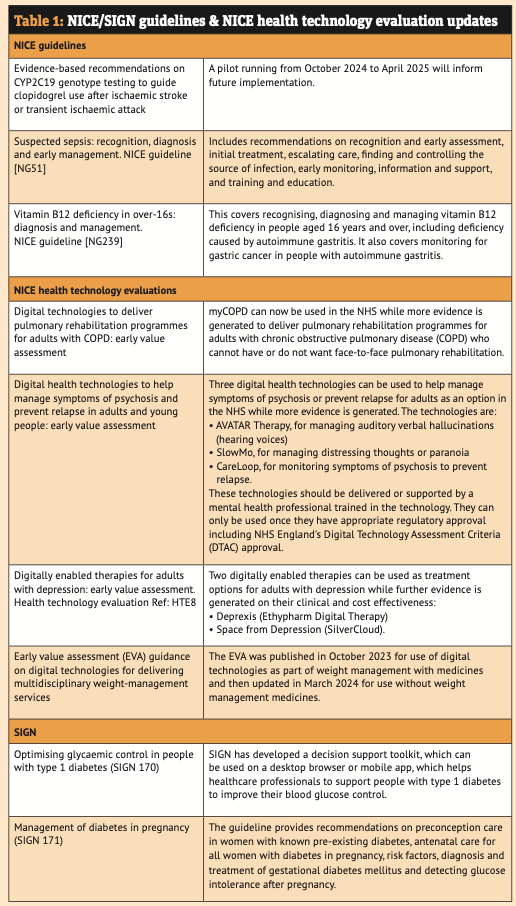
In another update, NICE continued its evaluation of digital technologies as an alternative to face-to-face services and made recommendations about their use in pulmonary rehabilitation, relapse prevention in psychosis and the treatment of depression.