




 15 Min
 In CPD Modules

Follow this topic

Bookmark

Record learning outcomes
Rod Tucker, BPharm, PhD, clinical pharmacy writer
After completing this module, pharmacists will be able to describe how, as prescribers, they can contribute towards better disease management and improved patient support.
|
||||||||||||||||||
Why take this module?
Chronic plaque psoriasis (CPP) is a common condition that affects around 3% of the UK population. Research suggests that patients often feel health professionals lack sufficient knowledge to support them. This CPD module aims to provide an up-to-date understanding of psoriasis as a chronic, multisystem inflammatory disease rather than merely a skin disorder.
It also provides information on important comorbidities and triggers, particularly psoriatic arthritis, obesity, smoking, stress and medication-related exacerbations. The module is designed to improve pharmacists’ confidence in managing the condition in primary care, including through prescribing appropriate use of topical therapies, emollients and maintenance treatment.
Finally, the module will help pharmacists develop practical counselling skills to support adherence, educate patients on correct topical application, and provide lifestyle advice that may contribute to improved disease outcomes and quality of life.
Introduction
In the past, psoriasis was often considered to be ‘just’ a skin problem. However, it has become increasingly apparent that psoriasis is a much more complex disease than originally thought. Indeed, it is best considered as a chronic, non-contagious, multisystem inflammatory disorder that affects many people.
According to a recent global analysis, psoriasis prevalence has been estimated at 4.4% across 20 countries. In the UK, psoriasis is believed to affect 2.8% of the population. Although not life-threatening, psoriasis is associated with a significant impairment of quality of life, leading to social stigmatisation, higher levels of stress, depression and physical limitations. In fact, the visible nature of psoriasis has been reported as one of the worst aspects of the disease.
Psoriasis affects both sexes equally and, for most patients, the condition first presents between the ages of 15 and 25 years. Others are often affected between 55 and 60 years of age.
While there are several different forms of psoriasis (see Table 1), the most common presentation – accounting for up to 90% of cases – is chronic plaque psoriasis (CPP). This module will focus on managing chronic plaque psoriasis and how community pharmacists can assess and, where necessary, treat patients with the disease.
|
Reflection exercise Before reading on, rate your own confidence in each of the following areas, where 1 is least confident and 5 is most confident. Where you feel less confident, what is/are the specific aspects you want to refresh and extend your knowledge and skills?
|
Clinical presentation
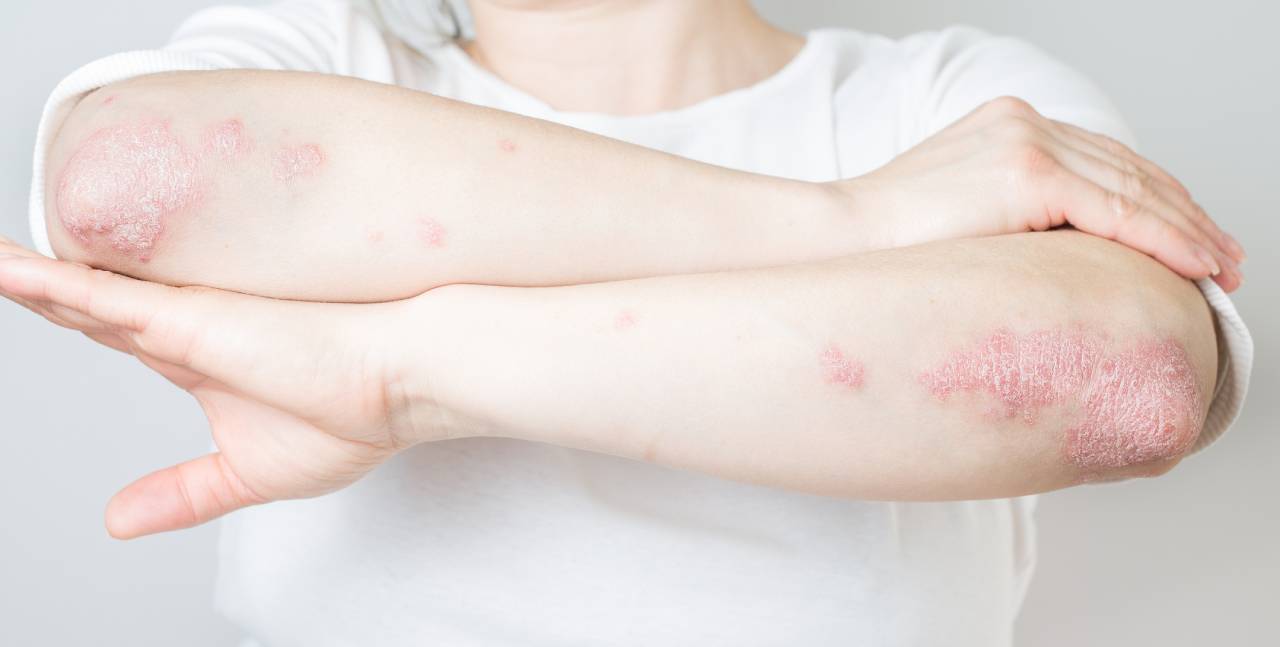
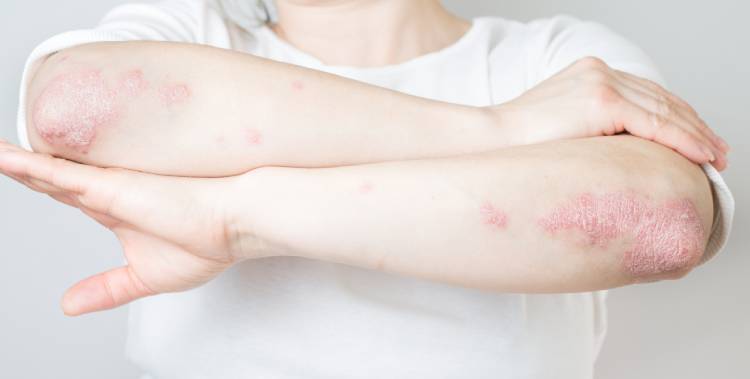
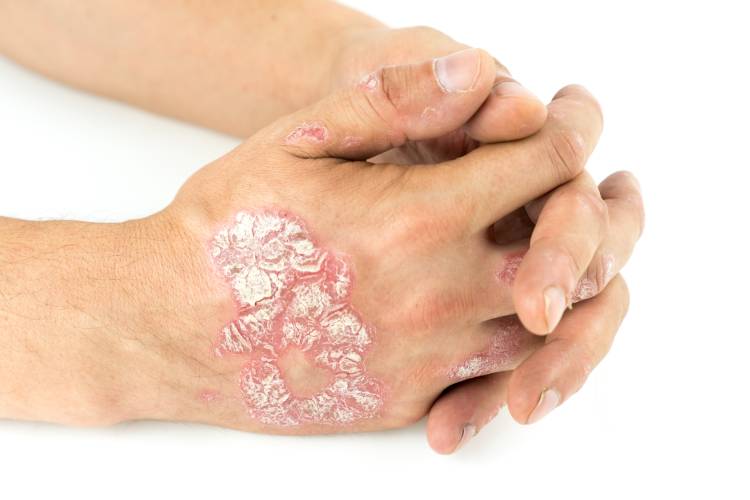
Chronic plaque psoriasis is characterised by well-defined, erythematous plaques with silvery-white hyperkeratotic scale that typically occurs on the extensor surfaces, such as the elbows, knees and lower back.
Up to 80% of patients also have scalp psoriasis. Psoriasis can affect the nails, causing characteristic pitting, subungual hyperkeratosis (a build-up of keratinous material beneath the nail) and onycholysis, where the nail separates from the nail bed.
Comorbidities and risk factors
Several lifestyle factors are associated with worsening disease severity in psoriasis. These include:
- Cigarette smoking
- Higher body mass index
- Alcohol consumption
- Physical inactivity.
A potentially serious and debilitating comorbidity is psoriatic arthritis (PsA), a chronic inflammatory condition associated with progressive joint disease that may affect up to one-third of people with cutaneous symptoms. Screening for PsA can be undertaken using the Psoriasis Epidemiological Screening Tool (PEST), shown in Table 2, which is quick and easy for patients to complete.
Triggers
Inherited factors are important in psoriasis, with estimated 5.5 and 2.5-fold increased risks in individuals with affected first- and second-degree relatives, respectively. Psoriasis can also be triggered by:
- Skin trauma, where psoriasis develops at the site of an injury (known as the Koebner phenomenon)
- Climate, with symptoms often worse during colder weather
- Infections, particularly streptococcal
- Medicines, including antimalarial drugs, beta-blockers and NSAIDs.
Pathophysiology
The precise cause of psoriasis remains unclear, although a combination of genetic, environmental and immunological factors is likely to be involved.
At its simplest, the changes seen in psoriatic skin reflect alterations in the keratinocyte life cycle. Normally, keratinocytes are produced and replaced approximately every 28 days. In psoriasis, this life cycle is shortened to around five days, leading to a build-up of keratinocytes on the skin surface that appears as silvery-white scale.
Psoriatic plaques also show increased vasculature, reflecting the inflammatory component of the disease. Psoriasis is now recognised as a systemic inflammatory condition, supported by the effectiveness of biologic treatments that target specific inflammatory cytokines.
Patient assessment
The diagnosis of suspected CPP is relatively straightforward as plaques usually occur on extensor surfaces. However, in all cases of likely CPP, community pharmacists should adopt a holistic approach to assessment.
The first consideration is disease severity. In primary care, CPP is typically categorised as mild, moderate or severe, using body surface area (BSA) affected to assess the extent of the disease. The surface area of one of the patient’s hands, i.e. the flat palm and five fingers, represents roughly 1% of their total body skin area. Using this measure, mild psoriasis is defined as less than 3% BSA, moderate psoriasis as 3-10% BSA, and severe psoriasis as more than 10% BSA.
Patients with mild to moderate disease can be managed with topical therapies, whereas those with severe disease should be referred to their GP.
BSA helps assess the extent of disease involvement, but pharmacists should also check for signs of psoriasis in other areas. This includes:
- Checking the scalp, hands and nails
- Asking about genital involvement, which often presents as shiny, inflamed areas.
As psoriasis is associated with several comorbidities, further assessment is recommended. This should include using:
- QRISK3 to assess cardiometabolic risk
- PEST (see Table 2) to screen for joint involvement
- Dermatology Life Quality Index (DLQI) to assess the impact on wellbeing.
QRISK scores above 10% should prompt referral to the patient’s GP. Similarly, patients who score more than 3 on PEST require referral, while changes in the DLQI (see resources) can be used to monitor response to treatment.
| Table 1: Other presentations of psoriasis | |
| Form | Clinical appearance |
| Guttate | Small (1 to 10mm), oval, scaly, red-to-pink plaques over the whole of the body. More common in children and young people but can occur in adults |
| Inverse/flexural psoriasis | Shiny, red, well-defined lesions with no adherent scale seen on intertriginous regions of body (axilla, natal cleft, genital region) |
| Palmoplantar pustular psoriasis | Series of sterile pustules occurring on hands and feet. A more generalised form of pustular psoriasis can occur anywhere on the body. Associated with systemic symptoms such as fever and chills |
| Erythrodermic psoriasis | Generalised redness of skin; often occurs after a worsening of psoriasis. Can occur acutely or develop over a few days or even weeks |
| Table 2: Psoriasis epidemiological screening tool (PEST) questions |
Patients answering ‘yes’ to three or more questions should be referred to a rheumatologist. |
|
Reflection exercise Before continuing, reflect on how effectively you usually counsel patients with psoriasis. Rate your confidence in the following areas, where 1 is least confident and 5 most confident:
|
Management
This section considers the treatments and practical advice that all community pharmacists can recommend or provide for people with chronic plaque psoriasis.
Emollients
There is currently no cure for CPP and the disease follows a relapsing-remitting course. Fortunately, up to 80% of patients with CPP have mild to moderate disease that is suitable for treatment in primary care with topical therapies. Community pharmacists who are not independent prescribers can still support treatment for people with CPP, particularly when the disease is mild. In these cases, an emollient may be all that is needed.
| There is no current cure for CPP and the disease follows a relapsing-remitting pattern |
Pharmacists and their teams can help patients find a cosmetically acceptable emollient, as this is more likely to be used regularly. Emollients play an important adjunctive role in psoriasis by softening and hydrating the stratum corneum and enhancing desquamation (shedding of hyperkeratotic skin). Although atopic eczema is widely recognised as an itchy skin condition, pharmacists should also be aware that psoriasis can also cause significant pruritus.
As CPP is a dry skin condition, an emollient should be used as a soap substitute in the bath or shower and applied after washing. Application should involve long, smooth strokes in the direction of hair growth to help hydrate the skin. Vigorous rubbing increases skin friction, which can worsen pruritus or trigger the Koebner phenomenon – the appearance of new psoriatic skin lesions on previously unaffected skin.
Emollients can be applied to pruritic lesions throughout the day. Patients should be advised not to pick or scratch them, as this can lead to bleeding. All patients with CPP should use an emollient, regardless of other active treatments. Pharmacists should ask whether patients with psoriasis use an emollient and, if not, help them choose a suitable preparation. In practice, most patients prefer a lighter, less greasy product during the day and a richer ointment at night to help prevent nocturnal cracking.
When recommending an emollient, pharmacists should advise applying it about 30 minutes before any active treatment, as this enhances absorption of the active therapy. Adults with CPP typically use about 500g per week of their chosen emollient. Pharmacy teams should alert patients to the fire risk associated with some paraffin-based emollients.
Scalp psoriasis
Pharmacists can treat mild scalp psoriasis with coal tar-based shampoos. However, where lesions have thickened plaques, a descaling agent with anti-inflammatory, antipruritic and anti-scaling properties should be used before a coal tar product.
Descaling products such as Cocois or Sebco ointment should be massaged generously into the affected areas and left in contact for at least two hours, or preferably overnight. After two hours, or the next morning, a mechanical comb can be used to lift off the softened scale before washing.
When using a coal tar-based shampoo, patients should leave the product on the skin for five to 10 minutes before washing it out. Treatment should continue until the scale becomes much thinner. If scalp psoriasis is controlled with a coal tar product, it can be used once or twice a week as maintenance therapy. If the scale begins to thicken again, patients can resume using a descaling agent.
There are several treatment options for scalp psoriasis when cases fail to respond to OTC coal tar products. Prescription products contain either potent topical corticosteroids, vitamin D analogues, or a combination of both.
Evidence suggests that the combination of a potent topical corticosteroid and vitamin D analogue is the most effective therapy, although there is limited evidence to support the use of other treatments.
Independent prescribing
Community pharmacists in Wales and Scotland who are independent prescribers can initiate topical therapy for people with CPP. Although several topical treatments are available, current NICE guidance focuses on vitamin D analogues and potent topical corticosteroids.
Initial treatment should include a potent topical corticosteroid, such as betamethasone, and a vitamin D analogue, such as calcipotriol. These should both be applied once daily at different times, for example morning and evening.
Patients should be reviewed after four weeks and managed according to their response:
- If the response has been good, treatment should continue – but the potent corticosteroid should be stopped after eight weeks
- If patients do not achieve a satisfactory response after four weeks, assess adherence and cosmetic acceptability. With no obvious reasons for the poor response, the same treatment should continue for a further four weeks
- If there is still no improvement after eight weeks, the potent topical corticosteroid should be stopped and the vitamin D analogue continued alone for up to 12 weeks
- If the response remains inadequate after 12 weeks, the potent corticosteroid can be restarted for another four weeks, or a coal tar product applied once or twice daily
- If treatment failure continues, short contact dithranol can be used.
Studies suggest that four weeks of treatment with a potent topical corticosteroid plus a vitamin D analogue produces around a 75% reduction in disease severity.
Stepping down treatment
After active treatments, such as topical corticosteroids or a vitamin D analogue, patients can stop these products once their skin is clear or nearly clear and has flattened. However, they should continue using emollients to help with skin hydration.
Treatment can be restarted when the disease flares. For patients who experience frequent flares, twice-weekly application on non-consecutive days of a combination product, such as Enstilar foam, can help maintain remission.
In contrast to NICE guidance, the Primary Care Dermatology Society recommends calcipotriol and betamethasone as a combination product first-line to encourage rapid improvement and adherence in CPP. Examples include Enstilar foam for the body and scalp, Wynzora cream, and Dovobet gel and ointment.
Two newer topical treatments for psoriasis – the phosphodiesterase-4 inhibitors roflumilast and crisaborole – are also available.
Supporting patients
Treatment adherence
Community pharmacists can help patients by supporting treatment adherence. Studies suggest that people living with psoriasis frequently manage their condition sub-optimally and in isolation from healthcare professionals because of a lack of adequate advice about treatment. These findings highlight the need for more effective community-based information, education and support for psoriasis patients.
A small-scale study of community pharmacist support for patients living with psoriasis did lead to significant improvements in their understanding of the condition, disease severity and quality of life. Although adequate adherence is crucial, pharmacists should also ensure that patients do not continue using a potent topical corticosteroid at the same site for more than eight weeks.
Lifestyle advice
Pharmacists can also support people with psoriasis by providing lifestyle-directed advice. Many patients ask whether dietary changes could help improve their condition and a recent trial explored whether the Mediterranean diet could affect disease severity. After 16 weeks of following the diet, 47.4% of participants achieved a 75% improvement in disease severity.
Some patients report that vitamin D supplementation improves their skin symptoms, but there is little objective evidence to support this claim. Other studies indicate that, where appropriate, weight loss can lead to a small but significant improvement in disease severity. In addition, combining dietary changes with increased physical activity can reduce disease severity by up to 48% in overweight patients with psoriasis.
In line with the improvements seen following phototherapy, many patients report that sun exposure improves disease severity. However, excessive exposure to the sun or the use of sunbeds is not recommended, particularly for people with a fair complexion or those who are prone to burning, because of the increased risk of skin cancer.
| Useful resources |
|
|
Prescribing case study David Matthews is a 42-year-old finance manager who comes to your pharmacy complaining of worsening pruritic, scaling and inflamed skin patches on his elbows, knees and lower back over the last six months. What do you advise? He reports that the scaling has become increasingly thick, causing the skin to crack and bleed. He also has hypertension, for which he takes ramipril 5mg daily. In the past, David has tried using E45 cream on his skin but says it is too greasy and has not really helped. He is a social drinker, consuming roughly 20 units of alcohol per week and smokes around 10 cigarettes a week. He also reports having little time for exercise. On examination, you notice well-demarcated, erythematous, scaling plaques on both his elbows and knees, with a few small patches on his lower back. David has minimal scalp involvement and no evidence of nail pitting. You diagnose chronic plaque psoriasis and estimate that it affects about 4% of his body surface area. His DLQI score is 11, indicating a significant impact on his quality of life, largely because of intense pruritus, work-related embarrassment and sleep disruption. His PEST score was 1 because of occasional heel pain. His QRISK score was 6.1. Treatment plan Following NICE guidance, you prescribe a combination of a potent topical corticosteroid and a vitamin D analogue, advising David to apply the steroid in the morning and the vitamin D analogue at night. You describe the fingertip unit for the amount of topical steroid to apply, explaining that one fingertip unit should cover an area of skin roughly the size of two adult flat hands. David is advised to continue this regimen for at least four weeks, after which he will be reviewed. In addition, you add Epaderm cream (500g) and recommend that he applies it 30 minutes before each active treatment and throughout the day if his psoriasis remains pruritic. You counsel David to stop his topical steroid and vitamin D analogue once his skin has flattened, even if it appears red. You explain that the redness will fade and advise him to continue using Epaderm. You also suggest that David should try to stop smoking and cut down on his alcohol intake, both of which are potential triggers for his psoriasis. |

Share:


In CPD Modules
CPD modules help to expand your clinical knowledge on a whole range of topics. Make sure you log your learning so you can track your progress and add to your online revalidation record.